When U.S. warships line the Caribbean horizon and diplomatic tension snaps like a bowstring, narratives multiply fast.
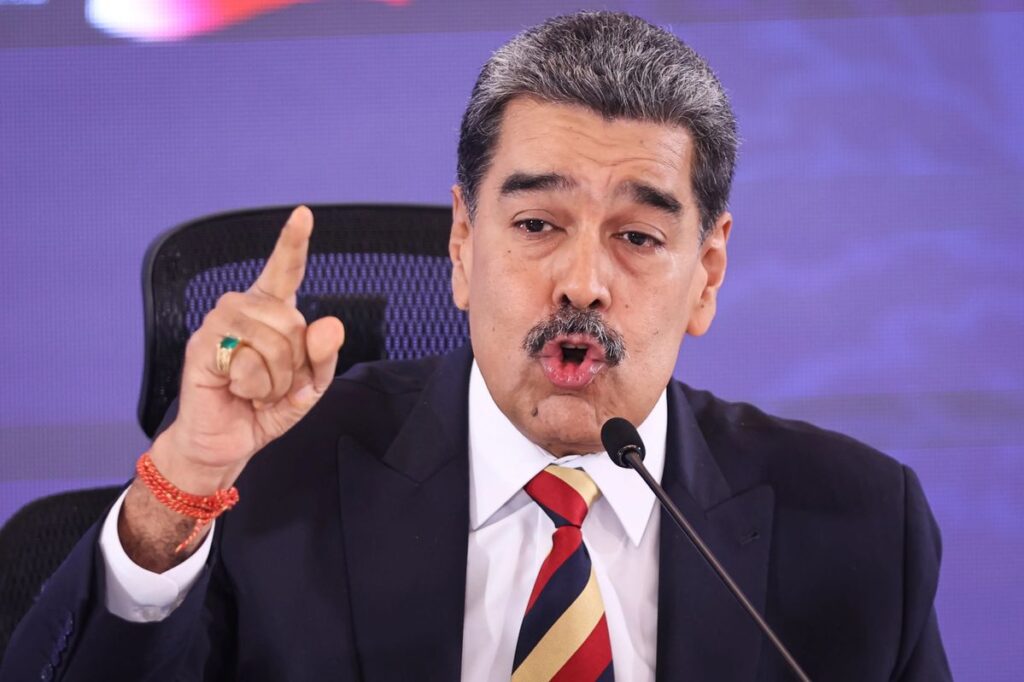
But one voice has been especially loud — Nicolás Maduro, who insists that the sudden surge of American military muscle near Venezuela has nothing to do with drug-trafficking operations and everything to do with one thing:
Oil.
Venezuela’s oil.
The largest proven reserves in the world.
According to Maduro, Washington’s “anti-narco operations” are just a shiny wrapper on an old geopolitical craving — control the oil, control the region, control the future.
But is the story really that simple?
🛢️ Maduro’s Claim: “They Want Our Natural Resources”
Maduro’s argument is straightforward and emotionally charged:
- The U.S. wants regime change to take Venezuela’s oil, gas, and minerals.
- The military buildup is a pretext to intimidate Caracas.
- Venezuela’s sovereignty — not drug boats — is what’s under attack.
It’s a narrative tailored for history books: a small nation guarding its resources against a superpower’s ambition.
And around Latin America, that message travels well.
🔍 But the Reality Is Messier
Yes, Venezuela sits on staggering reserves.
But industry experts point out that much of that oil is heavy, expensive to refine, and trapped in a broken energy system. Years of mismanagement and sanctions have left production crippled.
In other words:
Venezuela is still a resource giant — but not an easy one to plunder.
That complicates the “they just want the oil” storyline. There may be some truth — oil always matters — but it’s unlikely the only motive behind the U.S. pressure campaign.
🔥 The Real Game: Not Just Oil, But Power
Mix together:
- a strategic Caribbean gateway,
- a hostile government aligned with Russia, Iran, and Cuba,
- an authoritarian regime presiding over humanitarian collapse,
- and a U.S. president eager to project strength…
…and suddenly the picture expands beyond crude.
Oil is a piece of the puzzle.
But influence, pressure, regime change, regional dominance — those are equally powerful drivers.
🎯 Why Maduro Pushes the Oil Narrative Anyway
Because it works.
Framing the U.S. as an empire lusting after oil:
- Rallies his domestic base
- Wins sympathy abroad
- Shifts focus away from Venezuela’s internal crises
- Turns a geopolitical struggle into a moral one
In politics, the simplest story often wins — even if the truth lives in the gray areas.
🧭 Final Take
Maduro may be right that oil is part of the equation.
But the full picture?
It’s a geopolitical mosaic — where oil is one tile among many.
The Caribbean is no longer calm.
The stakes are rising.
And the world is watching a familiar drama unfold:
when powerful nations move fleets toward resource-rich shores, motives are never pure — and never singular.
📚 References
- Maduro’s claim that the U.S. aims to “seize” Venezuela’s oil — and his call on OPEC+ for support — as U.S. military presence increases. euronews+1
- Reporting that outlines the massive U.S. military buildup near Venezuela + strikes on alleged drug-smuggling vessels — noting that Caracas says these actions threaten not only Venezuela’s security but its oil production and export capability. Al Jazeera+2Al Jazeera+2
- Data pointing out Venezuela’s oil industry troubles — even though the country holds among the world’s largest proven oil reserves. This helps explain why analysts view the “oil motive” as plausible yet not straightforward. Al Jazeera+1
- Commentary and analysis arguing that there are multiple overlapping motivations behind U.S. pressure on Venezuela: anti-drug strategy, regime change, strategic influence — with oil being one factor among others. The Guardian+2The Guardian+2
- Recent media summary: “Maduro says the real reason for Trump’s Venezuela fixation is oil — is he right?” from The Guardian, which explores Maduro’s claims and provides expert push-back and context. The Guardian