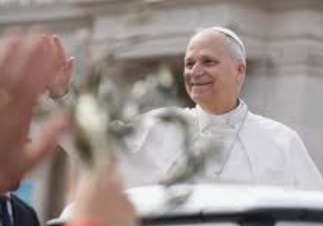
In a powerful and deeply symbolic Palm Sunday address, Pope Leo XIV firmly rejected the notion that war
can ever be justified in the name of God, delivering a message that resonates far beyond the walls of the Vatican and into a world increasingly marked by conflict and division.
Speaking during one of the most significant moments in the Christian calendar, the Pope used the occasion to confront what he described as a “dangerous distortion of faith”—the belief that divine authority can be invoked to legitimize violence. His remarks come at a time when religious rhetoric continues to surface in geopolitical conflicts, often fueling tensions rather than resolving them.
Palm Sunday, which commemorates the entry of Jesus Christ into Jerusalem, is traditionally a moment of reflection on humility, sacrifice, and peace. Against this backdrop, Pope Leo XIV’s message carried particular weight. Rather than focusing solely on spiritual themes, he addressed the urgent realities of the modern world, drawing a clear line between authentic religious teaching and its misuse for political or military ends.
“The name of God must never be used to bless destruction,” the Pope declared, emphasizing that faith, at its core, is a call to peace, reconciliation, and the protection of human dignity. He warned that invoking religion to justify war not only distorts sacred teachings but also deepens human suffering and prolongs cycles of violence.
His message reflects a broader concern within the global religious community about the role of faith in contemporary conflicts. In many parts of the world, religion remains a powerful force—capable of inspiring compassion and unity, but also vulnerable to manipulation. By addressing this issue directly, Pope Leo XIV positioned himself within a long tradition of religious leaders who have sought to reclaim the moral authority of faith as a force for peace.
The Pope’s remarks also highlight the ethical responsibility of leaders—both political and religious—to ensure that their words and actions do not inflame tensions. In an era of instant communication and widespread misinformation, narratives that frame conflicts in religious terms can spread rapidly, often with devastating consequences. By rejecting such narratives, the Pope is calling for a more responsible and truthful discourse.
Observers note that the statement is particularly significant given the current global climate. From ongoing regional conflicts to emerging geopolitical rivalries, the world is witnessing a period of heightened uncertainty. In some cases, religious identity has been intertwined with political agendas, creating complex and often volatile situations. The Pope’s message serves as a reminder that faith should not be weaponized in these contexts.
Beyond its immediate political implications, the address also carries a profound theological message. Christianity, like many other major religions, places a strong emphasis on peace, forgiveness, and the sanctity of life. By rejecting the idea that God can justify war, Pope Leo XIV is reaffirming these core principles and challenging believers to reflect on how they are lived out in practice.
The response to the Pope’s message has been largely positive, with many praising its clarity and moral conviction. Religious leaders from various traditions have echoed his call, emphasizing the need for interfaith cooperation in promoting peace. At the same time, some critics argue that the realities of global security are complex and that moral statements, while important, must be accompanied by practical solutions.
Nevertheless, the significance of the Pope’s words lies not only in their content but also in their timing. Palm Sunday marks the beginning of Holy Week, a period that culminates in Easter—a celebration of hope and renewal. By choosing this moment to address the issue of war and religion, the Pope is inviting believers to consider how the message of peace can be applied in a world that often seems defined by conflict.
The address also raises broader questions about the role of religion in public life. In many societies, religious institutions continue to wield significant influence, shaping values and guiding behavior. When used responsibly, this influence can be a powerful force for good. However, when misused, it can contribute to division and violence. The challenge, as highlighted by the Pope, is to ensure that faith remains aligned with its highest ideals.
In practical terms, this means promoting dialogue, understanding, and cooperation across cultural and religious boundaries. It also means holding leaders accountable when they attempt to use religion as a tool for political gain. By speaking out against such practices, Pope Leo XIV is setting a standard that others may be encouraged to follow.
The message is also likely to resonate with younger generations, who are increasingly engaged with issues of justice, equality, and global responsibility. For many young people, the idea that religion should be a force for peace rather than conflict is both intuitive and compelling. The Pope’s words may therefore contribute to a broader shift in how faith is understood and practiced in the modern world.
At the same time, the address does not ignore the complexities of real-world conflicts. While rejecting the justification of war in God’s name, the Pope acknowledged the challenges faced by nations in maintaining security and protecting their citizens. However, he stressed that these challenges must be addressed in ways that respect human dignity and uphold moral principles.
This balanced approach reflects an understanding that peace is not simply the absence of conflict, but the presence of justice, compassion, and mutual respect. It is a vision that requires effort, commitment, and a willingness to engage with difficult questions. By articulating this vision, Pope Leo XIV is contributing to an ongoing global conversation about the future of peace and security.
The impact of such messages should not be underestimated. Throughout history, religious leaders have played a crucial role in shaping public opinion and influencing social change. While they may not have direct political power, their moral authority can inspire individuals and communities to act in ways that promote peace and understanding.
In this sense, the Pope’s Palm Sunday message is both a warning and a call to action. It warns against the dangers of misusing religion to justify violence, while also calling on individuals, leaders, and institutions to work toward a more peaceful and just world.
As conflicts continue to challenge the international community, voices like that of Pope Leo XIV serve as an important reminder of the values that should guide human behavior. Whether these values can be fully realized in practice remains an open question, but their importance is undeniable.
Ultimately, the Pope’s rejection of the idea that God justifies war is a reaffirmation of a fundamental truth shared by many religious traditions: that the sacred is meant to unite, not divide; to heal, not harm. In a world searching for stability and meaning, this message carries enduring relevance.
As Holy Week unfolds, the words of Pope Leo XIV are likely to continue resonating across continents and cultures—challenging individuals and nations alike to reconsider the role of faith in shaping the future of humanity.