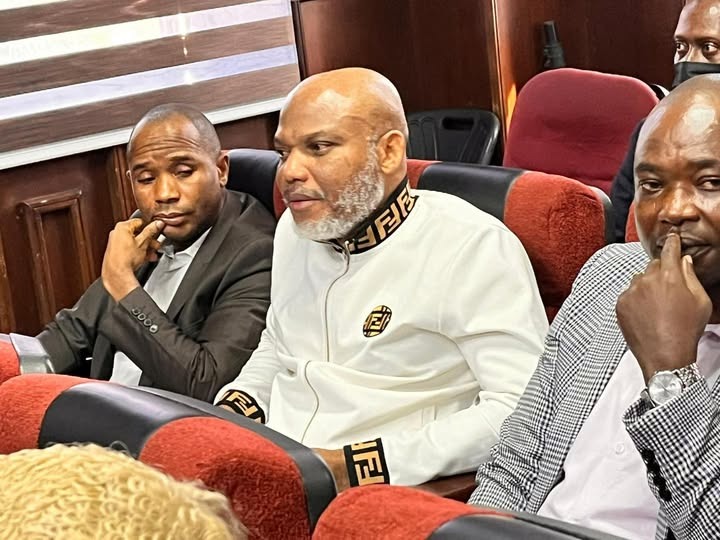
On 20 November 2025, the Federal High Court in Abuja delivered a judgment in the case of Nnamdi Kanu, leader of the Indigenous People of Biafra (IPOB). After a protracted and politically charged legal battle, Justice James Omotosho convicted Kanu on seven terrorism-related counts, sentencing him largely to life imprisonment.
The Verdict and Sentencing
- Kanu was found guilty on all seven counts included in the prosecution’s terrorism charges.
- He received a life sentence for counts 1, 4, 5, and 6.
- On count 3, he was sentenced to 20 years in prison; on count 7, he got 5 years.
- Notably, all sentences are to run concurrently — meaning they will overlap rather than one after the other.
- Justice Omotosho chose life imprisonment instead of the death penalty, citing both a moral imperative of mercy and the global trend against capital punishment.
Why He Was Convicted
The court determined that Kanu’s activities went beyond peaceful political agitation. Key factors included:
- His broadcasts on Radio Biafra, where he was accused of calling for violent attacks and inciting his followers.
- The issuance of “sit-at-home” orders in southeastern Nigeria, which the court viewed as a coercive strategy that disrupted daily life and constituted a form of “preparatory terrorism.”
- Alleged guidance to supporters on how to manufacture bombs and other violent means, which the court considered evidence of actual or planned violence.
- Threats made against diplomatic missions and security personnel, which under the Terrorism Prevention Act the court treated as serious and international in scope.
The judge also rejected Kanu’s argument that his actions were part of a legitimate self-determination struggle. He emphasized that, while self-determination is a political right, it must be pursued through constitutional and lawful means, not violence.
Reaction and Implications
- Kanu’s legal team has vowed to appeal the ruling. His former lawyer, Aloy Ejimakor, stated that they will take the case to the Court of Appeal.
- The verdict has already sparked strong reactions, especially among Igbo political and community leaders. Some see the judgment as more than a legal decision — a politically significant moment for southeastern Nigeria.
- In court, the judge ordered that Kanu be held in a secure facility, restricted from using digital devices, and placed under close supervision.
- He also ruled that certain broadcast equipment seized from Kanu should be forfeited to the federal government.
Broader Context
Kanu’s legal saga is deeply rooted in Nigeria’s post–civil war history. He has long been a controversial figure: to supporters, he represents the hope of Igbo self-determination; to the government, he is a major security risk. His re-arrest in 2021 (after previously fleeing abroad) and extradition from Kenya reignited attention on IPOB’s activities and the Nigerian state’s response to separatist movements.
int. On one hand, it marks a decisive legal victory for the Nigerian state in its battle against what it regards as extremist separatist activity. On the other hand, it risks deepening political and ethnic tensions. By choosing life imprisonment over any other type of sentencing .