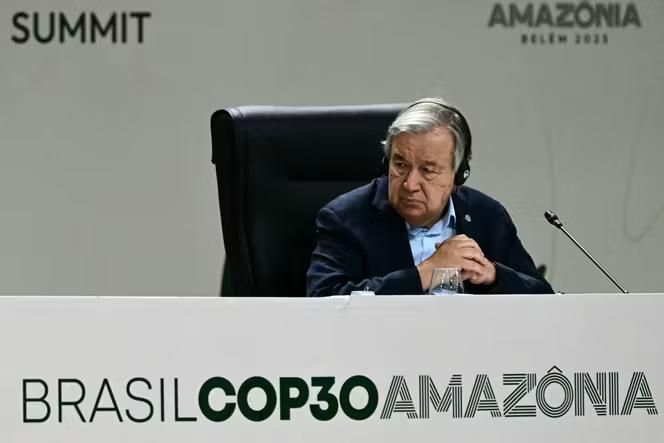
As the COP30 climate negotiations near their conclusion in Belém, Brazil, United Nations Secretary-General António Guterres has issued an urgent appeal for unity, responsibility, and meaningful progress. In a firm but hopeful message to nearly 200 nations, Guterres called on delegates to reach an “ambitious compromise” that protects the planet and keeps the 1.5°C global warming limit within reach.
A Defining Moment for the Planet
Guterres emphasized that the world is watching closely — especially those living on the frontlines of climate impacts. Communities are already experiencing devastating floods, crippling droughts, and worsening heatwaves. For many, climate change is no longer a scientific debate but a daily struggle for survival.
He reminded leaders that the decisions they make in Belém will shape the future of billions and determine whether humanity can avert the most catastrophic consequences of a warming world.
Compromise With a Red Line: The 1.5°C Goal
While urging countries to show flexibility, Guterres insisted that 1.5°C must remain a non-negotiable red line. He cautioned that insisting solely on maximal demands could risk deadlock, but compromising on the global temperature goal would risk the planet itself.
His message:
Be flexible — but not at the expense of the climate goal that underpins global safety.
Major Fault Lines at COP30
Delegates are currently debating several sensitive issues, including:
1. Fossil Fuel Phase-Out Roadmap
Brazil has proposed a detailed roadmap to phase out fossil fuels. Many nations support it, but some major oil producers have resisted, citing economic impacts and energy security concerns.
2. Insufficient Emissions Commitments
Some countries have come to the negotiations with weaker emissions-reduction plans, triggering criticism from those demanding stronger climate action.
3. Climate Finance for Developing Nations
Low-income and climate-vulnerable countries are pressing wealthier nations for stronger financial commitments to support mitigation, adaptation, and loss-and-damage recovery.
4. Trade and Transparency Challenges
Issues around trade barriers, carbon market rules, and transparency continue to complicate negotiations.
A Call to End the Blame Game
Guterres urged delegates to stop pointing fingers and instead focus on delivering practical, balanced outcomes. He warned that political posturing will only widen divides and risk rendering the summit ineffective.
He stressed that climate finance, transparent reporting, and credible fossil fuel commitments must all be part of the final agreement if the world hopes to maintain trust in the multilateral process.
Standing With the Most Vulnerable
One of the most powerful themes in Guterres’ address was solidarity with nations that are already suffering the worst climate impacts. For small island states facing rising seas and developing nations grappling with agricultural collapse, the stakes could not be higher.
He reiterated that climate justice requires listening to and prioritizing the needs of those who contribute least to the problem but suffer the most.
Why an “Ambitious Compromise” Matters
Guterres’ framing is deliberately strategic:
- It acknowledges geopolitical reality — major economies have competing interests that cannot be fully resolved overnight.
- It holds firm on scientific necessity — warming beyond 1.5°C means deadly consequences for millions.
- It keeps pressure on richer nations — financial and technological support remains a moral and practical necessity.
- It protects global trust — showing the world that even divided nations can choose cooperation over confrontation.
Challenges Ahead
The road to a climate deal remains difficult. Some countries are reluctant to commit to fossil fuel phase-outs. Others are debating financial responsibility, while technical disagreements over carbon markets and reporting standards persist.
Still, Guterres maintains hope that courage, empathy, and realism can guide negotiators toward a meaningful agreement.
A Turning Point for Global Cooperation
Ultimately, the UN chief’s call reflects a deeper truth: climate change can only be confronted through collective action.
An “ambitious compromise” does not mean settling for weak decisions — it means forging the strongest possible agreement under real-world conditions.
If nations succeed, COP30 could mark a turning point — not only for diplomacy, but for the future of life on Earth.
References
- Channel TV – UN Chief Calls for ‘Ambitious Compromise’ at Climate Talks.
- The Telegraph – UN Secretary-General urges flexibility from nations to achieve results at climate talks.
- RTL Today – ‘The world is watching’, says Guterres as he calls for ambitious compromise at COP30.
- Digital Journal – UN Chief calls for ‘ambitious compromise’ at climate negotiations in Brazil.
- BSS News – UN Chief calls for ambitious compromise amid tense climate negotiations.