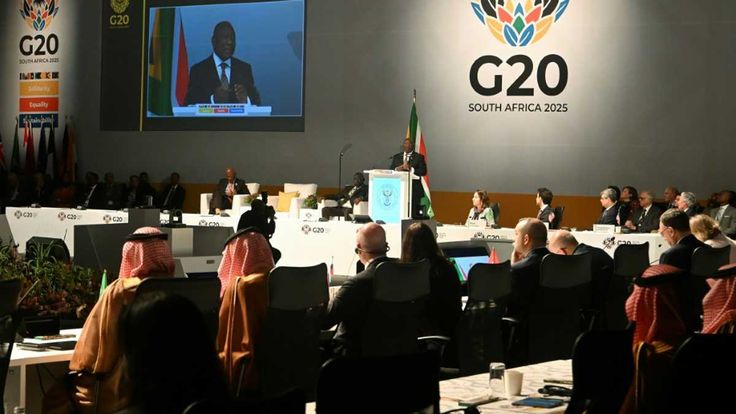
South Africa’s presidency of the G20 in 2025 represents a historic milestone — the first time an African nation leads the world’s most influential economic forum. Under President Cyril Ramaphosa, the country is using this moment to push for global equity, climate justice, and a stronger voice for developing nations. Yet, this leadership role unfolds amid diplomatic tension, domestic pressure, and high expectations.
1. A Historic Presidency with a Clear Vision
South Africa assumed the G20 Presidency with the theme “Solidarity, Equality, Sustainability.” This focus signals the nation’s intent to make the G20 more inclusive and responsive to the needs of the Global South.
Key events under its presidency include:
- The G20 Social Summit, engaging youth, women’s groups, faith communities, and civil society.
- The Parliamentary (P20) Summit, spotlighting global solidarity and sustainable development.
These platforms aim to broaden participation beyond heads of state and ensure ordinary citizens’ concerns shape global policy.
2. Priority Issues: Inequality, Climate & Economic Recovery
South Africa is using its presidency to highlight three urgent global priorities:
• Tackling Global Inequality
A major report on global wealth inequality, commissioned from leading economists including Nobel laureate Joseph Stiglitz, is expected to influence discussions on fairer global financial systems.
• Financing for Developing Nations
South Africa is advocating for new mechanisms to support:
- Debt sustainability
- Infrastructure development
- A just energy transition
• Climate Justice
The country continues pushing for increased climate finance, expanded renewable energy commitments, and a fair path toward decarbonization.
3. Economic Boost & Global Visibility
Hosting the G20 provides significant economic opportunities:
- Boosted tourism and international visibility
- Increased demand for services and infrastructure
- A platform to showcase South Africa’s culture, landscapes, and economic potential
More importantly, it strengthens the nation’s role as a bridge between developed and developing economies, enhancing its diplomatic influence.
4. Diplomatic Tensions & Global Politics
The summit has faced diplomatic headwinds, including friction with the United States, which notably chose not to attend the event. Despite such challenges, South Africa secured consensus on critical issues such as debt relief and climate commitments — a noteworthy achievement under complex geopolitical conditions.
5. Domestic Pressure: Gender-Based Violence in Focus
At home, gender-based violence (GBV) has taken center stage. Protests ahead of the summit demanded urgent government action. In response, the government declared GBV and femicide a national disaster, allowing for expanded resources and structural action.
This highlights how global events can accelerate domestic reform efforts.
6. Why This Moment Matters
South Africa’s G20 leadership is critical because it:
- Elevates Africa’s voice on the global stage
- Enables policy influence on global inequality, climate justice, and development
- Creates potential long-term legacy projects that could reshape global cooperation
If effective, this presidency could mark a transformative moment for both South Africa and the broader Global South.
References
Reuters – G20 summit in South Africa adopts declaration despite US boycott — Reuters
Associated Press – Leaders adopt a declaration at the start of South Africa’s G20 summit — AP News
The Guardian – South Africa declares gender-based violence a national disaster amid G20 protests — The Guardian+1
South African Presidency – Opening remarks by President Cyril Ramaphosa at the G20 Leaders’ Summit — Government of South Africa
Parliament of South Africa / P20 – 11th G20 Parliamentary Speakers’ Summit — Parliament of South Africa+1