
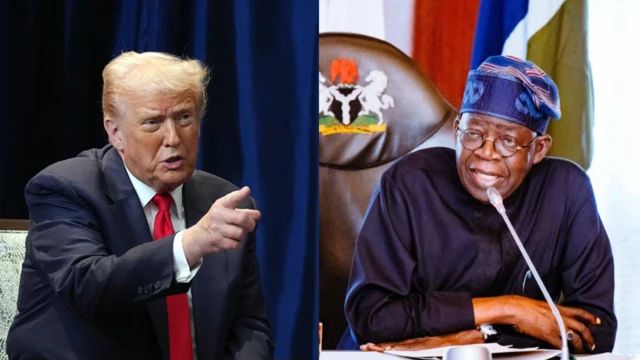
Recently, the United States Department of State announced new visa restrictions targeting Nigerians (and their relatives) considered responsible for “mass killings and violence against Christians.” The policy applies under Section 212(a)(3)(C) of U.S. immigration law, which allows denial of visas to those deemed responsible for serious human-rights violations.
✅ Why the U.S. Response Has Justifiable Grounds
- Accountability for violence — Nigeria has endured long years of attacks — by extremist groups, ethnic militias, and violent actors — that have harmed Christians and other citizens. By restricting visas for perpetrators, the U.S. is signalling that impunity for religious or communal violence will carry international consequences.
- Support for religious freedom — For victims and affected communities, such a move may offer international recognition of their suffering. It may also discourage violent actors from believing they can cross borders or travel freely.
- Human rights diplomacy — The visa ban can be viewed as part of broader global standards: when a state or individuals commit serious abuses, other countries have moral and diplomatic obligations to respond.
⚠️ Why Many Nigerians See the Policy as Problematic
- Risks of over-generalisation and stereotyping — The targeting of “Nigerians responsible for anti-Christian violence” risks reinforcing negative stereotypes about Nigeria as a whole. In fact, Nigeria is religiously diverse, and many conflicts stem from complex factors beyond religion — such as land disputes, poverty, resource competition, herder-farmer clashes — which affect people regardless of faith.
- Collateral damage on innocent Nigerians — The broader tightening of U.S. visa policy (e.g. shorter visa validity, more stringent vetting) has affected students, professionals, families seeking education, business, or legitimate travel.This could hurt people with no connection to violence or human-rights abuses.
- Strain on bilateral relations and cooperation — The government of Federal Republic of Nigeria has expressed concerns that such visa restrictions — especially when applied broadly — could undermine historic people-to-people ties, trade, education exchanges, and mutual respect in diplomatic relations.
- Complex causes of insecurity in Nigeria — Many experts argue that framing Nigeria’s violence solely as “religious persecution” may be misleading — neglecting socioeconomic, ethnic, governance, and security-system failures contributing to instability.
🧭 What a Balanced/Constructive Path Forward Might Look Like
- The visa ban policy should be targeted and specific — focused strictly on individuals credibly linked to violence, not broad categories or unverified allegations. That would protect innocent Nigerians while holding perpetrators accountable.
- Encourage transparent investigations and prosecutions within Nigeria — because ultimately, accountability should come from within: security, judicial and governance reforms. International visa sanctions should complement, not replace, domestic justice.
- Promote interfaith dialogue and address root causes — such as poverty, land/resource conflict, governance deficits — so that violence isn’t simplified as religious conflict when it often has multiple and overlapping drivers.
- Maintain respect for bilateral relations and people-to-people exchange — visa sanctions should not unduly punish ordinary Nigerians aiming for education, business, or cultural exchange, as that undermines long-term cooperation and mutual respect.
✅ Final Thoughts
The visa-restriction policy by the U.S. reflects legitimate concern for human rights and religious freedom, and in many cases, could help press for accountability. At the same time, Nigeria — its government and people — should not be painted with a broad brush. Violence in Nigeria is complex, and many victims (and would-be travellers) are innocent. If applied carefully — targeting individuals credibly tied to violence — the policy could be part of a broader push for justice. But if misapplied, it risks unfairly punishing ordinary Nigerians and deepening divisions.
The most just approach is one that combines international vigilance with domestic reforms: hold perpetrators accountable, address root causes, protect all citizens (Christian or Muslim), and preserve legitimate exchanges between nations.
📚 References
- “US to restrict visas of Nigerians responsible for violence against Christians” — AP / PBS / Associated Press. AP News+2PBS+2
- “US to impose visa ban on religious-violence perpetrators in Nigeria” — The Telegraph Nigeria. The Telegraph Nigeria
- “US to Restrict Visas of Nigerians Responsible for Violence Against Christians” — The Washington Post. The Washington Post
- “US to place visa restriction on sponsors of Christian genocide in Nigeria” — THISDAY LIVE. ThisDayLive
- “Rubio vows visa bans over ‘Christian genocide’ in Nigeria” — Vanguard News. Vanguard News