
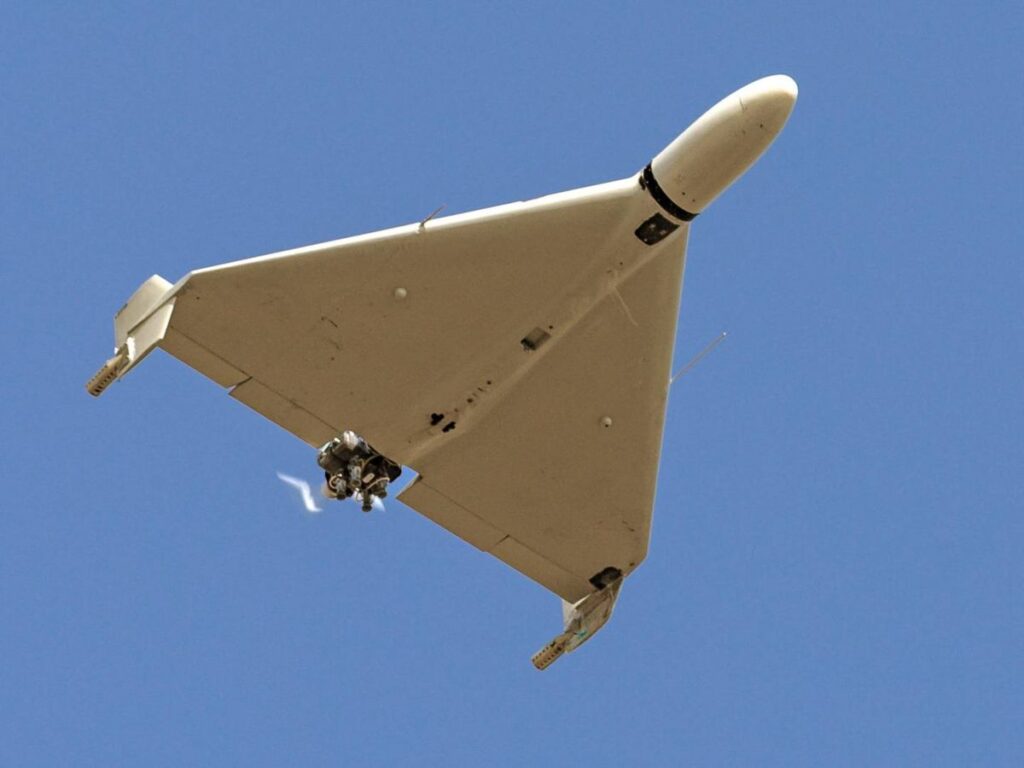
The U.S. Department of Defense has confirmed the development and deployment of a new low-cost attack drone known as LUCAS—an acronym for Low-Cost Uncrewed Combat Attack System—following extensive analysis of Iranian-made Shahed-136 loitering munitions captured or recovered in recent conflict zones.
Rather than a direct copy, U.S. defense officials describe LUCAS as a system inspired by the operational concept of the Shahed-136: a simple, expendable, one-way attack drone designed for mass deployment. The Iranian drone has been widely used by Russia in Ukraine and by Iran-aligned groups in the Middle East, demonstrating how relatively inexpensive systems can challenge advanced air defenses.
According to U.S. military sources, LUCAS was developed to address a growing gap in American capabilities. While the U.S. possesses highly sophisticated drones, many are costly and ill-suited for large-scale, attrition-based conflicts. LUCAS aims to provide a cheap, rapidly producible alternative that can be deployed in significant numbers.
Unlike the Shahed-136, which relies on relatively basic navigation systems, LUCAS reportedly incorporates U.S.-grade communications, navigation, and autonomy technologies, allowing for greater control, flexibility, and potential coordination with other unmanned systems. Officials emphasize that the drone is intended primarily as a deterrence and force-balancing tool, not a replacement for high-end platforms.
The Pentagon has begun operational use of LUCAS in the Middle East, where U.S. forces face persistent threats from armed drones. Military planners argue that matching low-cost threats with similarly priced counter-capabilities is both economically and strategically sound.
Iranian officials and state-aligned media have criticized the development, portraying it as evidence that U.S. forces were forced to emulate Iranian technology. Western analysts, however, note that reverse-engineering adversary systems is a longstanding military practice, used by major powers to adapt quickly to evolving battlefield realities.
Defense experts say the emergence of LUCAS highlights a broader shift in modern warfare, where simplicity, scale, and cost efficiency are becoming as important as technological sophistication. As drone warfare continues to evolve, the line between innovation and adaptation is increasingly blurred.
For the Pentagon, LUCAS represents less a concession to Iranian engineering and more a recognition that future conflicts may be decided not only by the most advanced weapons—but by the most adaptable ones.
References
- The War Zone (TWZ) – American-Made Shahed-136 Kamikaze Drone Clones Being Tested by Marines
(Detailed reporting on U.S. analysis and development of Shahed-inspired drones) - ABC News – U.S. Sends One-Way Attack Drones to the Middle East
(Confirms Pentagon deployment of low-cost loitering munitions and CENTCOM operations) - Newsweek – Iran Mocks U.S. for Copying Its Kamikaze Drone
(Covers Iranian reactions and official statements regarding LUCAS) - Iran International – Copies of Iranian Shahed Drones Deployed by U.S.
(Provides regional and Iranian perspectives on the issue) - Forbes – By Reverse-Engineering Shahed Drones, U.S. Adopts Low-Cost Warfare Model
(Strategic analysis of cost efficiency and military adaptation) - U.S. Central Command (CENTCOM) – Official statements and press briefings
(Primary source for deployment, mission intent, and operational framing) - International Institute for Strategic Studies (IISS) – Analysis on loitering munitions and drone warfare
(Context on global drone proliferation and military doctrine)