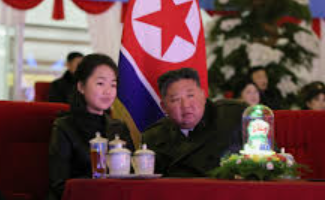
North Korea began the New Year with a carefully choreographed display of leadership symbolism as Kim Jong Un attended state festivities accompanied by his daughter, Ju Ae, a move that once again drew global attention to questions of succession, regime messaging, and the future direction of one of the world’s most closed political systems. While the appearance offered no formal announcement or policy shift, its symbolism was unmistakable in a country where public imagery is a central instrument of power.
The presence of Ju Ae at a high-profile New Year event reinforced a pattern that has gradually emerged since her first public appearance in late 2022. Each subsequent outing has been limited, deliberate, and heavily curated — prompting analysts to examine not only who appears beside the North Korean leader, but why, when, and in what context.
A Carefully Managed Public Image
In North Korea, public appearances by members of the ruling Kim family are never incidental. The state tightly controls imagery of its leadership, using visual symbolism to reinforce authority, continuity, and ideological legitimacy. Against this backdrop, Kim Jong Un’s decision to attend New Year celebrations with his daughter was widely interpreted as intentional messaging rather than a personal gesture.
The event itself followed familiar patterns: patriotic music, choreographed performances, and a celebratory tone aimed at projecting national unity and resilience. Ju Ae’s presence, however, introduced a generational dimension that subtly reframed the occasion. She appeared composed, formally dressed, and positioned prominently alongside her father — visual cues that carry meaning in a system where symbolism often speaks louder than official statements.
Ju Ae’s Emergence Into Public View
Ju Ae is believed to be Kim Jong Un’s daughter, though North Korea has never formally confirmed her status, age, or position within the ruling family. Her first known public appearance occurred in 2022 during a missile launch event, an unusual setting that immediately sparked global discussion. Since then, she has appeared intermittently at military-related occasions, cultural events, and now major calendar moments such as New Year festivities.
Each appearance has been notable not for frequency, but for selectivity. Ju Ae is not a constant presence in state media, nor has she been assigned any official title. Instead, her appearances are spaced out, highly symbolic, and framed within moments of national significance.
This pattern has led many observers to conclude that her visibility is less about immediate political function and more about long-term narrative construction.
Succession Speculation — Caution and Context
The sight of Ju Ae alongside Kim Jong Un has inevitably fueled speculation about succession. In a state defined by dynastic rule — from Kim Il Sung to Kim Jong Il to Kim Jong Un — the idea of preparing the public for a fourth-generation leader is not implausible.
However, experts caution against drawing premature conclusions. Kim Jong Un remains relatively young by global leadership standards, and there has been no indication of declining authority or internal challenge that would necessitate immediate succession planning. Moreover, North Korea’s political culture does not publicly designate heirs decades in advance in explicit terms.
Rather than a direct signal of imminent succession, Ju Ae’s appearances are widely viewed as symbolic positioning, reinforcing the durability of the Kim bloodline and projecting continuity far into the future.
The Role of Family in Regime Legitimacy
The Kim dynasty derives much of its legitimacy from a carefully cultivated mythology that blends revolutionary history, nationalism, and familial continuity. Images of Kim Jong Un with his daughter fit squarely within this tradition, presenting leadership not merely as an office, but as a hereditary trust passed across generations.
By showing himself as a father as well as a leader, Kim Jong Un humanises his image for domestic audiences while simultaneously reinforcing the idea that the nation’s future remains firmly anchored in the Kim family. In a system where loyalty to the leader is paramount, the projection of familial stability carries political weight.
Domestic Messaging: Stability and Permanence
For North Korean citizens, the New Year appearance conveyed a message of stability at a time of ongoing economic hardship, international sanctions, and regional tension. The image of a calm, confident leader attending celebrations with his child suggests continuity and control — a reassurance that the leadership is secure and forward-looking.
This messaging is particularly significant given North Korea’s emphasis on endurance and resilience. By linking national celebrations with generational imagery, the regime subtly communicates that its authority is not temporary or reactive, but enduring and rooted in lineage.
International Interpretation and Strategic Signaling
Outside North Korea, the appearance was read through a different lens. International observers and governments continue to monitor the country’s political signals for insight into future behavior, especially concerning military posture and diplomacy.
Ju Ae’s continued visibility has raised questions about whether North Korea is slowly acclimating foreign audiences to the idea of a future female leader — a notable departure from the country’s historically male-dominated power structure. Yet analysts remain divided on whether gender symbolism is intentional or incidental.
What is clear is that Pyongyang understands the global impact of its imagery. Each public appearance is calibrated not only for domestic consumption, but also for how it will be interpreted abroad.
Balancing Power and Normalcy
Another dimension of the New Year appearance lies in its contrast with Ju Ae’s earlier public outings, many of which were linked to military events. Appearing at a festive, civilian-oriented occasion broadens her symbolic association beyond weapons and defense, subtly integrating her image into everyday national life.
This shift may reflect an effort to balance North Korea’s portrayal as a militarised state with a narrative of cultural continuity and normal social rhythms — a particularly relevant message at the start of a new year.
What the Appearance Does Not Mean
Importantly, the New Year event did not include any formal announcement regarding leadership roles, titles, or future governance structures. There was no indication that Ju Ae holds any official position or that institutional changes are underway.
North Korea’s opaque system makes definitive conclusions difficult, and analysts consistently warn against over-interpretation. Symbolism in Pyongyang is powerful, but it is also layered and often deliberately ambiguous.
A Long-Term Narrative in Motion
Rather than a sudden shift, Ju Ae’s New Year appearance fits into a gradual narrative arc that has been unfolding over several years. The regime appears to be introducing her presence slowly, allowing familiarity to build without provoking resistance or destabilising expectations.
Whether this narrative ultimately leads to formal succession planning remains uncertain. What is clear is that North Korea is laying visual and psychological groundwork for continuity — a hallmark of dynastic systems.
Conclusion: Symbolism Over Certainty
Kim Jong Un’s decision to attend New Year festivities with his daughter was less a declaration than a signal — one open to interpretation but grounded in North Korea’s long-standing reliance on symbolism as a tool of governance.
In a political environment where words are sparse and images are deliberate, such moments matter. They shape perception, reinforce authority, and hint at futures without defining them.
As the New Year unfolds, Ju Ae’s role — whether symbolic, preparatory, or something else entirely — will remain a subject of close observation. For now, her presence alongside her father stands as a reminder that in North Korea, even celebration is a form of political communication.