In a development with far-reaching geopolitical consequences, United States President Donald J. Trump has confirmed that Venezuelan President Nicolás Maduro and his wife, Cilia Flores, have been captured and removed from Venezuelan territory following a U.S.-led military operation carried out in the early hours of Saturday.
The announcement signals one of the most consequential foreign interventions by the United States in Latin America in decades and represents a dramatic escalation in the long-running confrontation between Washington and Caracas.
According to President Trump, the operation concluded with Maduro and Flores being taken into custody and flown out of Venezuela. While full operational details remain classified, the confirmation has already triggered emergency diplomatic responses across the Americas and beyond.
Nighttime Strikes Shake Caracas
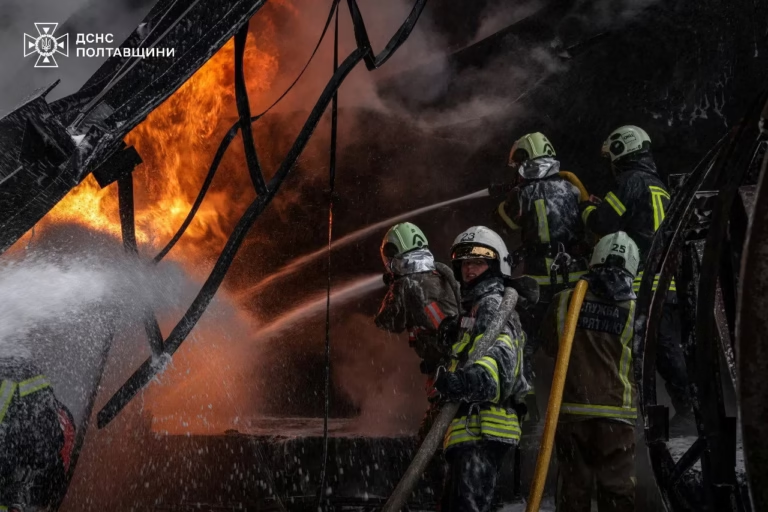
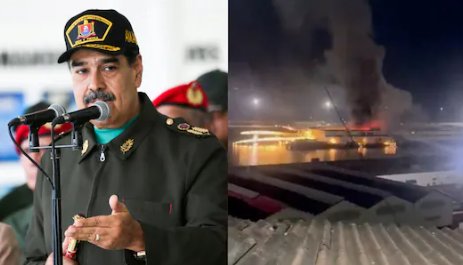
Residents of Caracas and nearby regions reported a night of intense military activity beginning shortly after 2:00 a.m. local time. Explosions echoed across parts of the capital as aircraft were seen flying at low altitude. Power disruptions were reported in several districts, and major roadways were temporarily shut down amid heightened security activity.
Although Venezuelan authorities initially described the events as isolated incidents, the scale and coordination of the operation quickly became evident as reports emerged of targeted strikes on strategic military installations and command facilities.
Within hours, President Trump publicly stated that the operation had succeeded in its primary objective: the capture of Venezuela’s president and first lady.
Trump Confirms Capture
In his statement, Trump described the mission as decisive and necessary, asserting that it was conducted with the involvement of U.S. law enforcement and military assets. He characterized the operation as a response to long-standing allegations against the Maduro government, including links to transnational crime, narcotics trafficking, and regional destabilization.
Trump also announced that he would address the nation and the international community later in the day, promising further clarity on the legal basis, scope, and objectives of the action.
No immediate clarification was given regarding the location where Maduro and Flores are being held, though officials indicated that they are no longer on Venezuelan soil.
Caracas Reacts With Alarm and Defiance
In Venezuela, senior government officials condemned the operation as a violation of national sovereignty and an act of foreign aggression. State television interrupted regular programming to broadcast emergency statements, while authorities announced heightened security measures across the country.
Vice President Delcy Rodríguez publicly demanded confirmation of Maduro’s condition and whereabouts, calling the operation “illegal and unprecedented.” Defense officials urged calm among the population while simultaneously calling on supporters to remain vigilant and prepared to defend the nation.
A temporary state of emergency was declared in parts of the country as military and police units were deployed to key infrastructure sites, including oil facilities, airports, and government buildings.
A Historic Rupture in U.S.–Venezuela Relations
The capture of a sitting head of state by foreign forces marks a watershed moment in hemispheric politics. While the United States has intervened militarily in Latin America in the past, such actions have become increasingly rare in the modern era, making this episode especially significant.
Relations between Washington and Caracas have been hostile for years, shaped by sanctions, diplomatic isolation, and mutual accusations. U.S. authorities have consistently portrayed the Maduro government as illegitimate, corrupt, and criminally compromised, while Venezuela has accused the United States of pursuing regime change under the guise of democracy and human rights.
This operation moves the conflict beyond rhetoric and economic pressure into direct action, fundamentally altering the diplomatic landscape.
International Reactions Begin to Surface
Global responses have been swift but cautious. Several Latin American governments called for restraint and emergency consultations, emphasizing the need to prevent regional instability. Others openly criticized the operation, warning that it could set a dangerous precedent for international relations.
Long-time allies of Venezuela denounced the capture and demanded Maduro’s immediate release, while multilateral institutions called for urgent dialogue to prevent further escalation.
The United Nations signaled that it was closely monitoring the situation and urged all parties to respect international law and protect civilian lives.
Legal scholars and foreign policy experts are already debating the legitimacy of the operation, particularly in the absence of a publicly stated international mandate.
Implications for Venezuela’s Political Future
With both the president and first lady removed from the country, Venezuela now faces profound uncertainty. Constitutional succession mechanisms could be triggered, but questions of legitimacy and authority loom large.
Potential outcomes include:
- A power struggle within the ruling political and military establishment
- Public unrest, either in protest or support, depending on regional and political loyalties
- Economic turbulence, particularly in the oil sector, which remains central to Venezuela’s economy
- Increased migration pressures, should instability worsen
Opposition figures have called for calm while urging the international community to support a peaceful political transition.
What Comes Next
Attention now turns to President Trump’s forthcoming briefing, which is expected to outline:
- The legal justification for the operation
- The status and treatment of Maduro and Flores
- Washington’s broader objectives for Venezuela
Markets, governments, and security agencies worldwide are bracing for ripple effects that could extend well beyond Latin America.
Conclusion
The confirmed capture of Nicolás Maduro and his wife represents a defining moment in 21st-century geopolitics. It collapses years of diplomatic stalemate into a single, decisive act that reshapes U.S.–Venezuela relations and raises profound questions about sovereignty, international law, and the future of political power in the region.
As events continue to unfold, the world watches closely—not only for what happens next in Venezuela, but for how this extraordinary episode may redefine the rules of global engagement in an era of rising geopolitical tension.