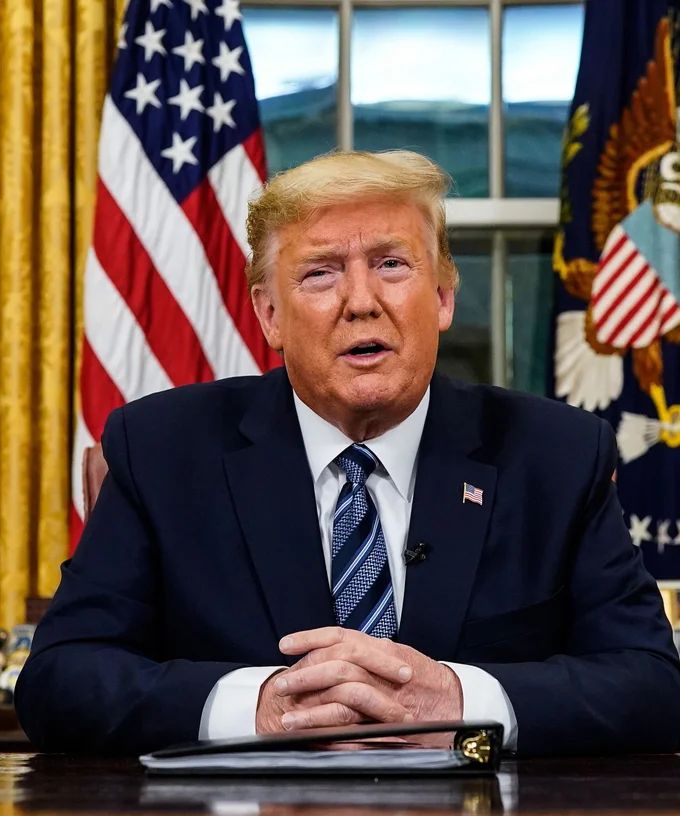
President Donald J. Trump addressed the United States, Venezuela, and the international community in a high-stakes speech that outlined Washington’s position following the dramatic political shift in Caracas. The address, firm in tone and sweeping in scope, framed recent U.S. actions as a decisive intervention aimed at stabilizing Venezuela and opening a path toward political renewal after years of turmoil.
From the outset, the President presented the moment as historic, arguing that Venezuela had reached a breaking point after prolonged economic decline, institutional paralysis, and political confrontation.
He described the situation not as an ordinary diplomatic dispute, but as a humanitarian and security challenge that, in his words, could no longer be ignored.
Ending What Trump Called a “Cycle of Collapse”
President Trump began by asserting that Venezuela’s crisis had extended far beyond politics. He spoke of a country once prosperous, now marked by shortages, mass emigration, and failing public services.
According to the President, successive efforts at negotiation and pressure had failed to produce meaningful reform, leaving ordinary Venezuelans trapped between economic despair and political deadlock. He argued that inaction would have meant allowing the crisis to deepen, with consequences for regional stability and global security.
“This was not a choice between intervention and neutrality,” Trump conveyed. “It was a choice between responsibility and abandonment.”
Temporary Administration, Not Permanent Control
A central theme of the speech was Trump’s insistence that U.S. involvement in Venezuela is temporary and limited in purpose. He rejected the idea of occupation or annexation, emphasizing that the United States does not seek long-term control over Venezuelan territory or institutions.
Instead, he described the U.S. role as that of a transitional guarantor—focused on maintaining order, protecting critical infrastructure, and preventing a power vacuum that could lead to violence or fragmentation.
He stated that American oversight would end once a credible political framework is established and Venezuelans are positioned to govern themselves through legitimate institutions.
“This is not the United States taking over Venezuela,” the President stressed in substance. “This is the United States helping Venezuela stand back up.”
Security, Services, and Stability
Trump outlined three immediate priorities for the transition period.
First, security. He said steps were being taken to prevent looting, armed disorder, and retaliatory violence. Protecting civilians, he noted, was essential to preventing chaos in the aftermath of sudden political change.
Second, continuity of essential services. Trump emphasized the importance of keeping electricity, fuel distribution, food supply chains, and medical services functioning. He argued that political change without basic stability would only worsen suffering.
Third, institutional preservation. Rather than dismantling the Venezuelan state, Trump said the objective was to preserve its core functions while removing what he described as corrupt and coercive control structures.
The Venezuelan People at the Center
Throughout the speech, the President returned repeatedly to the Venezuelan population, framing them as the primary stakeholders in the transition.
He stated that decisions made during the interim period would be guided by the principle that Venezuela ultimately belongs to its people—not to foreign powers, political factions, or armed groups.
Trump emphasized that Venezuelans would determine their future leadership through a lawful process once conditions allow, adding that no leader would be imposed by Washington.
“The future government of Venezuela will be chosen by Venezuelans,” he conveyed. “Not by the United States, not by force, and not by fear.”
Reports of Public Celebrations
As part of his address, President Trump acknowledged reports emerging from Venezuela following the announcement of political change. According to the President, information reaching U.S. officials and international media indicated that public celebrations had erupted in parts of the country.
He referenced scenes of people gathering in streets, playing music, dancing, and expressing relief after years of hardship. Trump described the atmosphere in some areas as emotional rather than organized—more spontaneous than political.
“These are not celebrations of America,” the President suggested in substance. “They are expressions of people who feel that a long chapter of suffering may finally be closing.”
At the same time, he cautioned against assuming uniform reactions nationwide. He acknowledged that Venezuela remains deeply divided and that not all citizens view recent events in the same way.
A Call for Calm and Restraint
Trump used the speech to urge Venezuelans across the political spectrum to remain calm. He warned against reprisals, vigilantism, or attempts to settle political scores.
According to the President, stability during the transition period would depend not only on external support but also on internal restraint and cooperation.
He directed a message to Venezuela’s security forces and civil servants, calling on them to continue performing their duties professionally and to avoid actions that could escalate tensions.
Message to the International Community
Turning outward, President Trump addressed foreign governments and international organizations, calling for what he described as “practical cooperation rather than ideological confrontation.”
He argued that the moment required humanitarian focus rather than geopolitical rivalry, urging countries to support food aid, medical assistance, and reconstruction planning.
Trump maintained that international involvement should reinforce, not undermine, Venezuela’s path back to self-governance.
“This is not a time to exploit instability,” the President conveyed. “It is a time to prevent suffering and support recovery.”
Legal and Moral Justification
While the President did not delve deeply into legal frameworks, he defended the U.S. position as grounded in necessity and responsibility. He framed the intervention as a response to extraordinary circumstances rather than a precedent for routine action.
Trump emphasized that the United States would be transparent about next steps and that further details would be released through official channels.
Uncertainty Ahead
Despite the confidence of the speech, the President acknowledged that the road ahead would not be easy. He described the transition as complex, fragile, and dependent on cooperation from multiple actors within and outside Venezuela.
He noted that celebrations in some areas coexist with fear and uncertainty in others, reflecting a nation still processing a sudden political shift.
Closing Message
President Trump concluded the address with a message aimed directly at Venezuelans, expressing optimism tempered by caution.
He portrayed the current moment as an opening rather than an endpoint—a chance to rebuild institutions, restore trust, and re-enter the global community with dignity.
“The world is watching Venezuela,” the President conveyed in closing. “Not to control it, but to see it rise again.”