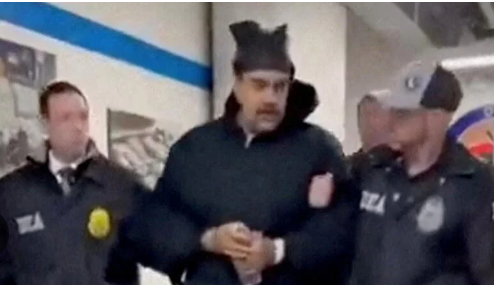
The arrival of Venezuelan leader Nicolás Maduro in the United States following a sudden and carefully executed operation has marked a decisive rupture in Venezuela’s long political crisis, while opening a new and highly consequential chapter in U.S.–Latin American relations.
President Donald Trump confirmed the operation in a brief but firm address, describing it as a necessary step after years of failed diplomacy, sanctions, and international mediation. He stated that the United States would assume a temporary coordinating role in Venezuela’s transition, remarking that Washington would “run Venezuela” during a short stabilization phase to prevent institutional collapse and wider regional instability.
Though the language was characteristically direct, officials later clarified that the intent was not permanent control, but an interim framework designed to restore order, protect civilians, and prepare the ground for Venezuelan-led governance.
A Sudden End to a Prolonged Stalemate
Maduro’s capture brings an abrupt conclusion to more than a decade of political paralysis. Under his leadership, Venezuela experienced one of the worst peacetime economic collapses in modern history, with hyperinflation, mass emigration, deteriorating infrastructure, and a breakdown of public trust in state institutions.
For years, the international community relied on sanctions, dialogue initiatives, and diplomatic isolation to pressure Caracas. Those efforts yielded little change on the ground. Trump’s decision to act reflects a judgment that existing strategies had reached their limit and that inaction now posed greater risks than intervention.
Supporters of the move argue that the operation reflects strategic realism rather than ideological adventurism—a belief that prolonged instability in Venezuela had become a regional security concern affecting migration, energy markets, and organized crime networks across the hemisphere.
Reactions Inside Venezuela
Within Venezuela, early reactions were mixed but revealing. In several urban centers, residents gathered in the streets, with music, celebrations, and visible relief marking what many described as the end of a long and exhausting chapter. For ordinary citizens, the moment was less about geopolitics and more about the possibility of economic normalization and personal safety.
At the same time, government loyalists and state media condemned the operation, framing it as an external assault on sovereignty. These divisions highlight the fragile social terrain any transitional authority will have to navigate.
Trump’s Calculated Message
Trump’s statement that the United States would “run” Venezuela, while controversial, aligns with his broader governing style—direct, unsentimental, and oriented toward outcomes. Administration officials emphasized that the phrase should be understood as administrative stewardship rather than occupation, pointing to plans for international coordination, humanitarian access, and institutional repair.
Rather than presenting the move as ideological victory, Trump framed it as a practical necessity. His remarks focused on restoring oil production, stabilizing public services, and preventing Venezuela from becoming a permanent failed state.
This approach reflects a consistent Trump-era view that prolonged disorder ultimately demands decisive leadership, particularly when existing governments are no longer functioning in the interests of their populations.
Maduro and the Question of Accountability
Maduro is expected to face long-standing U.S. legal charges, including allegations related to narcotics trafficking and organized crime. His transfer to U.S. custody underscores Washington’s insistence that political power does not confer immunity from the law.
Whether the legal process strengthens or complicates Venezuela’s path forward remains to be seen, but the symbolism is unmistakable: the era of impunity that shielded the country’s leadership has been decisively interrupted.
A Difficult Road Ahead
Despite the dramatic nature of recent events, Venezuela’s challenges remain immense. Institutions are weak, the economy is battered, and social trust has been deeply eroded. Trump has pledged humanitarian assistance and eventual elections, but the success of any transition will depend on Venezuelan participation and international legitimacy.
What distinguishes this moment is not rhetoric, but finality. The long political stalemate has ended. The question now is whether stability can replace stagnation.
If the transition delivers security, economic recovery, and a credible path back to self-rule, Trump’s decision will likely be viewed less as intervention and more as a turning point—one that forced movement where history had stalled.