By #Paulkizitoblog
Political Affairs Desk
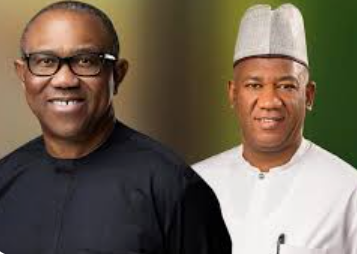
Nigeria’s opposition politics is entering a defining moment, and few figures embody its uncertainty more vividly than Peter Obi and his former running mate, Datti Baba-Ahmed. Once celebrated as symbols of a generational and ideological shift, the duo now stand at a political crossroads that could determine not only their own futures, but also the direction of reformist politics in Africa’s most populous nation.
Their 2023 presidential campaign under the Labour Party banner electrified a large segment of the electorate, particularly young Nigerians and urban professionals disillusioned with the country’s traditional political elite. The movement they inspired—popularly known as the “Obidient” movement—challenged long-standing assumptions about voter apathy, political loyalty, and the dominance of entrenched parties. Yet, as Nigeria moves further into a new political cycle, the question confronting Obi and Baba-Ahmed is no longer whether they can mobilize enthusiasm, but whether they can convert momentum into durable political structure and strategy.
From Electoral Surge to Strategic Pause
Peter Obi’s rise from a former governor with a reputation for fiscal restraint to a national opposition figure was rapid and largely organic. His campaign message of prudence, accountability, and human capital development resonated in a country grappling with inflation, unemployment, and insecurity. Datti Baba-Ahmed, an academic, businessman, and former senator, complemented that message with intellectual rigor and sharp critiques of Nigeria’s governance model.
However, electoral enthusiasm does not automatically translate into long-term political leverage. Since the elections, both men have faced the difficult task of redefining their roles outside the immediacy of a presidential race. The urgency that once unified supporters around a single objective has given way to competing expectations about what comes next.
Some supporters expect Obi to remain a constant, vocal presence—challenging government policy, leading protests against misgovernance, and positioning himself as a shadow president. Others argue that sustained relevance requires institution-building: strengthening party structures, winning local and state elections, and forging alliances that go beyond social media activism.
This tension has placed Obi and Baba-Ahmed at a strategic inflection point.
The Labour Party Dilemma
Central to their crossroads is the Labour Party itself. The party’s sudden prominence during the presidential election exposed both its potential and its fragility. Long accustomed to the margins of Nigerian politics, it was thrust into the national spotlight without the organizational depth typically required to manage such visibility.
Internal disagreements, leadership disputes, and questions about ideological coherence have since emerged. For Obi and Baba-Ahmed, the challenge is whether to invest political capital in reforming and consolidating the party or to consider broader coalitions that could offer a more stable platform for future contests.
Remaining within the Labour Party preserves the narrative of outsider reform and ideological consistency. However, it also risks confinement within a structure that may struggle to compete nationwide without significant overhaul. On the other hand, alliances with established political blocs could expand reach but dilute the moral clarity that initially attracted supporters.
The choice is not merely tactical; it is philosophical.
Datti Baba-Ahmed’s Evolving Role
While Peter Obi remains the more visible figure, Datti Baba-Ahmed’s position is equally significant. Known for his forthright commentary and constitutional arguments during and after the election period, Baba-Ahmed has cultivated a reputation as the intellectual backbone of the movement.
Yet, visibility can be a double-edged sword. His outspoken style has won admiration among supporters who value candor, while also attracting criticism from those who believe a more conciliatory tone is necessary in Nigeria’s polarized political climate.
At this crossroads, Baba-Ahmed faces a choice between remaining a principled critic of the system or transitioning into a more conventional political operator capable of building bridges across divides. His future influence will depend on how successfully he balances intellectual integrity with political pragmatism.
Managing the “Obidient” Movement
Perhaps the most complex challenge for Obi and Baba-Ahmed is managing the expectations of the movement that carried them to prominence. The “Obidient” base is diverse, decentralized, and highly motivated—but it is not a traditional political machine.
Many supporters view the movement as a moral crusade rather than a party project. This has created friction between idealism and the compromises inherent in politics. Calls for immediate systemic change coexist uneasily with the slow, negotiated processes required to achieve legislative and electoral victories.
If Obi and Baba-Ahmed fail to provide clear direction, the movement risks fragmentation or fatigue. Conversely, overly rigid control could alienate the very supporters who value its grassroots spontaneity. Navigating this balance is central to their political future.
Nigeria’s Broader Opposition Landscape
Their crossroads must also be understood within the wider context of Nigeria’s opposition politics. Traditional opposition parties are themselves in transition, reassessing strategies after recent electoral outcomes. This fluid environment presents both risk and opportunity.
Obi and Baba-Ahmed could emerge as unifying figures capable of reshaping opposition politics around issues rather than ethnicity or patronage. Alternatively, missteps could relegate them to symbolic relevance—admired for what they represented, but sidelined in practical power calculations.
History offers cautionary lessons. Nigerian politics is littered with movements that captured public imagination only to dissipate when confronted with the realities of organization, funding, and elite negotiation.
The Road Ahead
At this moment, Peter Obi and Datti Baba-Ahmed are neither fully ascendant nor politically diminished. They occupy a space of possibility, defined by public goodwill but constrained by structural realities. Their decisions in the coming months—how they engage with party politics, whether they pursue coalition-building, and how they remember and reshape their movement—will determine whether their 2023 surge becomes a footnote or the foundation of a lasting political realignment.
For millions of Nigerians who invested hope in their candidacy, the crossroads is not merely personal; it is symbolic. It represents the broader question of whether Nigeria’s political culture can evolve beyond cyclical disappointment toward sustained reform.
The answer will not come from rhetoric alone. It will emerge from organization, patience, and the difficult art of translating popular sentiment into enduring political power.