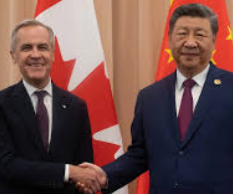
Canada’s Prime Minister Mark Carney has arrived in Beijing on a high-stakes diplomatic visit aimed at stabilizing and strengthening relations with China, as Ottawa looks to reduce its heavy economic reliance on the United States amid mounting tariff pressures and a rapidly shifting global trade order.
The visit marks a significant recalibration of Canada’s foreign and economic policy, signaling a willingness to engage more pragmatically with the world’s second-largest economy after years of strained ties driven by political disputes, security concerns, and trade frictions.
Canadian officials say the talks will focus on restoring dialogue, expanding market access, and identifying areas of cooperation in finance, climate policy, and supply-chain resilience.
Trade diversification at the core
At the heart of Carney’s trip is Canada’s growing concern over overdependence on the U.S. market, particularly as protectionist policies and tariff threats increasingly shape American trade strategy. With the United States accounting for the majority of Canadian exports, policymakers in Ottawa have been under pressure to broaden trade relationships and reduce exposure to sudden policy shifts south of the border.
China, despite its political sensitivities, remains one of the few markets large enough to absorb Canadian energy, agricultural products, critical minerals, and financial services at scale.
“Canada is pursuing a more balanced global trade posture,” a senior Canadian official said, describing the visit as part of a long-term strategy rather than a short-term pivot.
Repairing a damaged relationship
Relations between Ottawa and Beijing have been tense for much of the past decade, marked by diplomatic freezes, trade restrictions, and mutual accusations. Carney’s visit represents the most serious attempt yet to move beyond that impasse, even as Canada continues to voice concerns over human rights, national security, and rules-based trade.
Chinese officials have welcomed the visit as a sign of renewed engagement, emphasizing the need for “mutual respect” and non-interference. State media framed the talks as an opportunity to reset relations on more stable footing amid global economic uncertainty.
Global trade winds are shifting
The timing of the visit is notable. Global trade patterns are being reshaped by geopolitical rivalry, regional conflicts, and a growing trend toward economic nationalism. For middle powers like Canada, navigating between major blocs has become increasingly complex.
Analysts say Carney’s background in global finance gives added weight to the trip, particularly as discussions are expected to touch on currency stability, green finance, and multilateral economic reform.
“This is about hedging risk,” said one trade analyst. “Canada isn’t abandoning the U.S., but it is clearly signaling that it wants options.”
A careful balancing act
Despite the diplomatic outreach, Canadian officials have stressed that closer engagement with China does not mean abandoning core values or security commitments. Ottawa is expected to continue coordinating closely with allies, even as it pursues selective cooperation with Beijing.
For now, the visit reflects a broader reality facing many U.S. partners: as trade becomes more politicized, diversification is no longer optional—it is strategic.
Whether Carney’s Beijing trip produces tangible breakthroughs remains to be seen. But its message is already clear: Canada is testing a more flexible foreign policy in a world where old economic assumptions no longer hold.