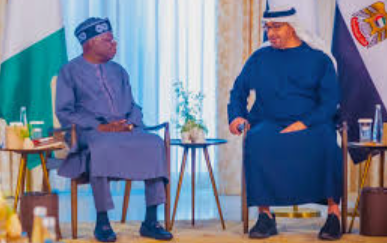
President Bola Ahmed Tinubu’s presence in Dubai has again drawn attention, not for fanfare, but for the quiet diplomacy that often defines high-level power negotiations away from public glare. Dubai, long a neutral ground for political dialogue, business recalibration, and strategic reset, has increasingly become a preferred location for discreet engagements involving African leaders.
Although no elaborate official programme has been publicly announced, Tinubu’s Dubai visit is widely understood to be tied to consultations on economic coordination, political stabilization, and elite-level engagements that require privacy rather than spectacle. Such settings allow frank conversations on governance, investment flows, and internal political alignments without the pressures of domestic optics.
For Nigeria, Dubai represents more than luxury or transit. It is a financial nerve center, a hub for global capital, and a backchannel venue where sensitive discussions — from investor confidence to political mediation — can be handled efficiently. Tinubu’s administration has consistently signaled a preference for results-driven diplomacy over performative statecraft, and this visit aligns with that approach.
The timing is also notable. Nigeria is navigating fiscal reforms, political realignments, and international repositioning. Engagements held outside the country often reflect an effort to stabilize key relationships, reassure stakeholders, and manage internal tensions with minimal noise.
While critics may question foreign meetings, history shows that many consequential political and economic decisions affecting Nigeria have been shaped in similar quiet environments. Tinubu’s Dubai presence appears less about visibility and more about leverage — positioning Nigeria within evolving regional and global dynamics while consolidating authority at home.
As with previous such visits, the outcomes may only become clear weeks or months later, when policy shifts, reconciliations, or economic signals begin to surface.