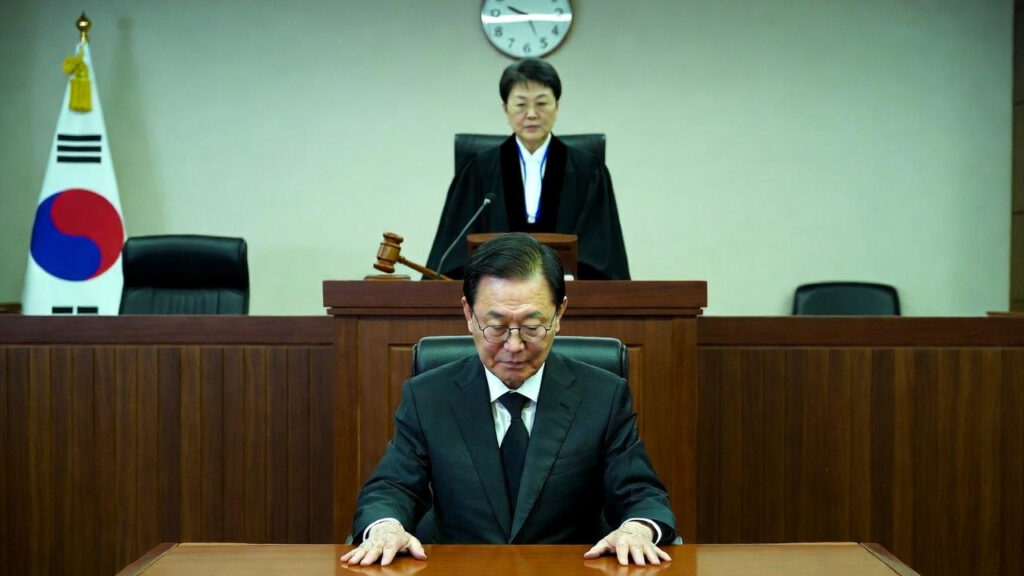
In a landmark verdict on January 21, 2026, a South Korean court sentenced former Prime Minister Han Duck-soo to 23 years in prison, ruling that his involvement in the December 2024 martial law crisis amounted to an act of rebellion and insurrection that threatened the country’s constitutional order.
The Seoul Central District Court found Han — a veteran political figure who also briefly served as acting president during the crisis — guilty of aiding and abetting the unconstitutional declaration of martial law, failing to properly exercise his constitutional duties, and engaging in related offences, including perjury and document falsification.
Court Finds Martial Law an Insurrection
The ruling marked the first time a former prime minister in South Korea has been convicted on such serious charges tied directly to an attempt to undermine democratic governance. In its judgment, the court concluded that the martial law declaration on December 3, 2024, which deployed military and security forces and briefly restricted civilian control, was an insurrection designed to subvert democratic institutions.
According to the decision, Han played a pivotal role by helping to orchestrate a cabinet “meeting” intended to give the martial law decree a veneer of legal legitimacy, even though it did not meet constitutional requirements. The judge described the actions as a “top-down insurrection” that posed a serious threat to the nation’s democratic fabric.
“The defendant was a prime minister who had been indirectly given democratic legitimacy and responsibility… Nevertheless, the defendant chose to turn a blind eye…and participate as a member of the December 3 insurrection,” the court said.
Sentence Exceeds Prosecutors’ Recommendation
Prosecutors originally sought a 15-year prison term, but the court imposed a significantly longer sentence, reflecting the gravity with which it viewed the offences and their potential impact on South Korea’s democratic institutions. Han, aged 76, was ordered to report to prison immediately after sentencing.
The sentence also included findings that Han had engaged in acts of perjury, falsification of official documents, and the destruction of records to disguise the unlawful nature of the martial law decree.
Han has denied most of the charges, insisting he never supported the martial law plan and voiced concerns to President Yoon at the time. He is expected to appeal the ruling to South Korea’s Supreme Court.
Political Turmoil and Martial Law Crisis
The December 2024 crisis erupted when then-President Yoon Suk Yeol — facing intense political opposition and a fractious legislature — declared a state of martial law and attempted to use the military to influence civic institutions, including the National Assembly and the National Election Commission.
The decree was quickly rebuffed by lawmakers who forced their way into a military-blocked Parliament, after which the order was rescinded within hours. Nevertheless, the episode sparked mass protest, impeachment proceedings, and a prolonged legal reckoning.
Yoon himself was removed from office by the Constitutional Court and sentenced earlier this month to five years in prison on related charges, including obstructing justice and abusing power during the martial law incident. Prosecutors are pursuing further charges against him, including for allegedly masterminding the rebellion; in one of those cases, they have even sought the death penalty, although South Korea has not executed anyone since 1997.
Han Duck-soo’s Role and Career
Han Duck-soo is a long-serving technocrat and political figure who served as prime minister under several administrations before his involvement in the 2024 political crisis. During the martial law attempt, he assumed the role of acting president after Yoon’s impeachment before later resigning to pursue his own presidential bid — an effort that ultimately failed when his party declined to endorse him.
The court’s verdict highlighted Han’s failure to oppose threats to democratic order and his active participation in attempts to provide procedural cover for unconstitutional actions.
Legal and Democratic Implications
South Korea’s democratic system, established after decades of military rule in the late 20th century, has robust institutions meant to resist executive overreach. The martial law crisis and its legal aftermath represent a stark test of those institutions’ resilience.
The criminal proceedings against Han and Yoon are part of a broader judicial effort to hold senior political figures accountable for actions deemed unconstitutional and harmful to democratic governance. Analysts say the rulings could shape future boundaries of executive power and serve as a powerful precedent in protecting constitutional order.
Public Reaction and Next Steps
The verdict has drawn significant public attention both domestically and internationally, with many South Koreans seeing it as a critical moment for accountability and the rule of law. Others, particularly political allies of Han and Yoon, have criticised the proceedings as politically motivated or excessively punitive.
Han’s legal team is preparing an appeal that will take the case to the Supreme Court, possibly extending the legal battle into late 2026 or beyond. Meanwhile, the fate of Yoon in his own insurrection trial — with a verdict expected in February — remains a focal point of national political drama.