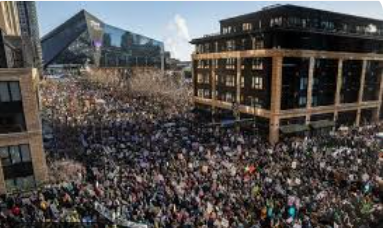
On January 30, a planned nationwide general strike and wave of coordinated protests is set to unfold across the United States, marking one of the most ambitious labor mobilizations in recent years. Organized in opposition to expanded federal immigration enforcement and deportation policies, the strike represents a convergence of labor activism, immigrant rights advocacy, and broader dissatisfaction with economic and political power structures.
Unlike traditional strikes confined to a single industry or employer, this action is explicitly political in scope. Organizers are calling on workers across sectors — from service and logistics to education and healthcare — to withhold labor, participate in demonstrations, or engage in acts of economic noncooperation. The goal is not only to disrupt business as usual, but to force national attention onto the human and economic consequences of aggressive immigration enforcement.
At the center of the protest is a growing belief that immigration policy has become inseparable from labor rights. Expanded enforcement actions and large-scale deportations do not occur in a vacuum; they reshape workplaces, weaken bargaining power, and create climates of fear that ripple far beyond immigrant communities. For many workers, particularly in industries reliant on migrant labor, enforcement crackdowns are experienced as a tool that suppresses wages, discourages organizing, and fragments solidarity.
The strike also reflects frustration with the limits of conventional political channels. While immigration remains a defining issue in U.S. elections and public debate, policy outcomes have often shifted regardless of popular protest or electoral promises. Organizers argue that withdrawing labor — the foundation of economic productivity — is one of the few remaining ways to exert meaningful pressure on decision-makers.
Critics of the strike contend that a general work stoppage risks economic harm without guaranteeing policy change. Business groups warn of supply chain disruptions and lost wages, while some political leaders frame the action as irresponsible or unlawful. Supporters counter that disruption is precisely the point. From their perspective, the everyday functioning of the economy already depends on the precarity of undocumented and mixed-status workers, and exposing that dependency is a form of political truth-telling.
What distinguishes this moment is the breadth of its coalition. Labor unions, grassroots immigrant organizations, student groups, and faith-based networks have all played roles in mobilization. Social media has amplified coordination efforts, allowing decentralized participation even in regions where formal strike protections are weak or absent. Rather than a single centralized shutdown, the action is expected to manifest as uneven but widespread disruptions, symbolic walkouts, and public demonstrations.
The timing of the strike is deliberate. It comes amid intensified enforcement rhetoric and high-profile deportation actions that have reignited fear within immigrant communities. For many participants, January 30 is less about a single policy demand than about drawing a clear moral boundary — asserting that economic stability cannot be built on mass displacement and criminalization.
Historically, general strikes have been rare in the United States, where labor law and political culture place significant constraints on collective action. When they do occur, they tend to signal moments of deep systemic tension. Whether or not this strike achieves immediate policy concessions, it reflects a broader shift in how immigration is being framed: not only as a border issue, but as a workplace issue, a human rights issue, and a question of who bears the costs of enforcement-driven governance.
The outcome remains uncertain. Participation levels will vary, enforcement responses may be uneven, and political reactions will likely polarize further. Yet the strike’s significance lies less in its scale than in its message. By linking immigration enforcement to labor power, organizers are challenging a long-standing divide in American politics — and testing whether solidarity across status lines can translate into sustained pressure for change.
January 30 may not resolve the national debate over immigration. But it underscores a reality that policymakers cannot easily dismiss: when immigration enforcement is experienced as economic punishment, resistance is likely to emerge not only at the border, but across the workplace itself.