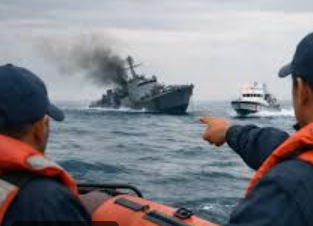
Authorities in Sri Lanka have recovered 87 bodies following the dramatic sinking of an Iranian warship off the island’s western coastline, an incident that has sharply escalated tensions across the Indian Ocean and
injected a volatile new dimension into already fragile global security dynamics. The vessel, identified by regional defense analysts as belonging to the naval wing of the Islamic Revolutionary Guard Corps, was reportedly struck by torpedoes launched from a submerged United States Navy submarine during what Washington has described as a “defensive maritime engagement.”
The Sri Lankan Navy confirmed that search-and-recovery operations began shortly after debris fields were detected roughly 45 nautical miles off the coast near Negombo. Fishing vessels in the area were the first to report a loud underwater detonation, followed by a plume of smoke and flames rising briefly from the surface before the vessel disappeared beneath the waves. Within hours, Sri Lankan maritime patrol craft and divers were dispatched to the scene, initiating what has become one of the most complex peacetime naval recovery missions in the country’s recent history.
According to preliminary assessments from Colombo, 87 bodies have been retrieved so far, with dozens more feared missing. Officials have not released the full manifest of the ship’s crew, but regional intelligence estimates suggest the warship may have carried between 110 and 130 personnel. The identities of the recovered sailors are being coordinated through diplomatic channels with authorities in Iran, while Sri Lankan forensic teams work to document and preserve remains in accordance with international maritime law.
The incident has triggered a wave of diplomatic shock. Tehran has condemned the strike as an “unprovoked act of aggression,” accusing the United States of violating international waters and destabilizing a critical maritime corridor. Iranian state media have framed the sinking as evidence of what they call “maritime intimidation” by Washington, warning of consequences for what they characterize as a direct assault on Iranian sovereignty.
Washington, however, maintains that the engagement followed what it described as “hostile maneuvering” by the Iranian vessel. In a brief statement, Pentagon officials asserted that the submarine commander acted in response to credible intelligence indicating imminent risk to U.S. and allied maritime assets operating in the region. While the exact sequence of events remains contested, U.S. officials insist the strike complied with established rules of engagement under international law.
The waters off Sri Lanka occupy a strategic position in the Indian Ocean sea lanes, linking the energy-rich Middle East with manufacturing hubs in East Asia. Roughly one-third of global maritime trade passes through these routes annually. Although Sri Lanka is not a party to the confrontation between Tehran and Washington, its geographic location has placed it at the crossroads of intensifying naval rivalries.
Colombo now finds itself navigating a delicate diplomatic path. The Sri Lankan government has emphasized its neutral stance, calling for restraint from all sides while prioritizing humanitarian recovery efforts. President and defense officials have reiterated that Sri Lankan waters must not become a battleground for external powers. Privately, analysts note that Sri Lanka’s balancing act reflects its broader foreign policy approach: maintaining constructive ties with major global players while avoiding entanglement in great-power conflicts.
The involvement of a U.S. submarine underscores the increasingly shadowed nature of naval competition. Submarines, by design, operate unseen, projecting power silently beneath the surface. Their deployment in contested maritime zones heightens both strategic ambiguity and escalation risks. Unlike surface confrontations, submarine engagements can unfold rapidly, often with limited opportunity for de-escalation once weapons are launched.
Security experts point out that tensions between Washington and Tehran have simmered for years, spanning disputes over nuclear development, sanctions, and regional proxy conflicts. Naval incidents in the Persian Gulf have been frequent, but a confrontation extending into the Indian Ocean marks a significant geographic expansion. It signals that strategic competition between the two powers is no longer confined to traditional flashpoints in the Gulf but is now unfolding across wider maritime theaters.
For Sri Lanka, the humanitarian dimension is immediate and sobering. Recovery divers describe challenging underwater conditions, including strong currents and limited visibility. Debris scattered across the seabed has complicated retrieval efforts. Local hospitals and morgues have been placed on alert, and grief counseling services have reportedly been offered to affected communities, particularly fishermen who witnessed the explosion.
The tragedy also raises questions about the legal status of the waters in which the strike occurred. Maritime boundaries in the Indian Ocean are clearly delineated under the United Nations Convention on the Law of the Sea (UNCLOS), but interpretations of “self-defense” within international waters remain contentious. Legal scholars argue that determining the lawfulness of the strike will hinge on whether credible evidence exists of an imminent threat posed by the Iranian vessel.
Regional powers are watching closely. India, whose southern coastline lies just across the Palk Strait from Sri Lanka, has expressed concern about the militarization of adjacent sea lanes. New Delhi has long regarded the Indian Ocean as central to its security doctrine and may see the incident as justification for expanding maritime surveillance and naval readiness. China, another key stakeholder in Sri Lanka’s economic and port infrastructure landscape, has called for de-escalation and respect for sovereignty, reflecting Beijing’s interest in preserving stable trade routes.
Energy markets have responded nervously. Although the clash occurred far from the Strait of Hormuz, investors fear that broader escalation could disrupt oil shipments or trigger retaliatory actions in other chokepoints. Shipping insurers have reportedly begun reassessing risk premiums for vessels traversing parts of the Indian Ocean, a move that could increase global freight costs if tensions persist.
Within Iran, public reaction has been marked by anger and mourning. State television has broadcast images of families gathering in prayer vigils, while officials promise a thorough response. The Iranian leadership faces pressure to demonstrate resolve without triggering an uncontrollable escalation. Historically, Tehran has favored calibrated retaliation, often through asymmetric means, but the loss of an entire naval vessel and dozens of sailors intensifies domestic expectations.
In the United States, the incident is likely to fuel debate over the scope of naval operations and the risk calculus guiding submarine deployments. Lawmakers may seek classified briefings to understand the intelligence that informed the decision to strike. Public opinion could hinge on whether evidence convincingly supports Washington’s claim of defensive necessity.
For Sri Lanka, beyond diplomacy and recovery logistics, there is a broader lesson about the vulnerabilities of small states situated along strategic crossroads. The island nation has long leveraged its geography as an economic asset, developing ports and maritime services that connect global supply chains. Yet geography can also attract unwanted attention when rival powers project force into adjacent waters.
The coming days will test diplomatic channels. Calls for an independent maritime investigation are already growing, with some international observers suggesting that a neutral fact-finding mission could help clarify contested narratives. Transparency, they argue, may reduce the risk of miscalculation or retaliatory spirals.
Ultimately, the sinking of the Iranian warship off Sri Lanka’s coast is more than a tragic maritime accident. It represents a flashpoint in the evolving architecture of global naval competition. As 87 families mourn fallen sailors and divers continue their solemn work beneath the waves, governments grapple with strategic calculations that extend far beyond the Indian Ocean horizon.
Whether this episode becomes a contained crisis or the opening chapter of wider confrontation will depend on the choices made in Washington, Tehran, and regional capitals. For Sri Lanka, the priority remains humanitarian and sovereign: recovering the dead, safeguarding its waters, and preventing its coastline from becoming the frontline of a conflict not of its making.