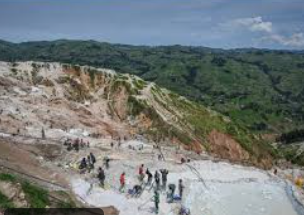
At least 200 people are feared dead following a catastrophic coltan mine collapse in eastern Democratic Republic of the Congo, local authorities have said, in what could become one of the deadliest mining
disasters in the country’s recent history. The tragedy unfolded in a remote, conflict-affected area where oversight is limited, infrastructure is fragile, and control of mineral resources remains fiercely contested. As rescue efforts continue, armed rebel groups operating in the region have disputed the official death toll, claiming the number of casualties is either significantly lower or being manipulated for political reasons.
The collapse reportedly occurred at an artisanal mining site in North Kivu province, an area rich in mineral deposits but plagued by insecurity. Coltan — short for columbite-tantalite — is a dull metallic ore used to produce tantalum, a critical component in smartphones, laptops, electric vehicles, and other high-tech devices. The global demand for electronics has turned eastern Congo into a strategic mineral hub, even as the region struggles with chronic violence and weak governance.
Provincial authorities said the collapse happened after heavy rainfall destabilized the pit walls of the open mine, causing tons of earth and rock to bury miners who were working underground. Witnesses described hearing a deep rumble before the ground caved in, trapping hundreds of workers inside narrow shafts reinforced only by wooden supports. Many of the miners were believed to be working without protective gear or proper structural safeguards.
Rescue efforts began almost immediately but have been severely hampered by the lack of heavy equipment. Local volunteers, fellow miners, and community members reportedly used shovels and bare hands to dig through debris in a desperate attempt to reach survivors. Officials said that by late evening, dozens of bodies had been recovered, with hundreds more feared buried beneath unstable soil. Authorities later revised the provisional death toll upward to at least 200, though they cautioned that the figure could rise as search operations continue.
However, a rebel faction active in the region, widely believed to be affiliated with the March 23 Movement, challenged the official count. In statements circulated through local media networks, representatives of the group accused government officials of inflating casualty figures for political gain and failing to provide adequate oversight of mining operations. The rebels claim that their own sources on the ground suggest a lower number of fatalities, though they did not provide independent verification.
The disputed toll underscores the broader instability in eastern Congo, where multiple armed groups compete for territorial control and access to lucrative mineral sites. The region has long been a flashpoint of violence, with militias, local defense groups, and foreign-backed factions vying for influence. The government in Kinshasa has repeatedly accused rebels of exploiting mining communities to finance their activities, while rebel leaders counter that the state has neglected the region’s development and security needs.
Coltan mining in Congo is dominated by artisanal and small-scale operations. Unlike large industrial mines, these sites are often informal, unregulated, and reliant on manual labor. Workers dig deep shafts into the earth, sometimes descending dozens of meters without modern reinforcement systems. Safety protocols are minimal or nonexistent. When collapses occur, they can be swift and deadly.
Human rights organizations have long warned about the dangerous conditions facing artisanal miners in eastern Congo. Many workers are drawn to the mines by poverty and lack of alternative employment. Some are migrants from neighboring provinces; others are local residents supporting extended families. The promise of daily cash income, however small, often outweighs the risks of injury or death.
The Congolese government has pledged to investigate the collapse and hold mine operators accountable. Provincial officials said a commission of inquiry would be established to determine whether safety regulations were ignored or whether illegal excavation contributed to the disaster. Yet critics question whether such investigations will produce meaningful change in a region where enforcement capacity is limited and corruption allegations persist.
The collapse also highlights the global dimension of Congo’s mining industry. Coltan extracted from artisanal sites often enters complex supply chains that stretch across Africa, Asia, Europe, and North America. International electronics manufacturers have faced mounting pressure to ensure that the minerals used in their products are conflict-free and responsibly sourced. Certification initiatives and traceability programs have been introduced over the past decade, but enforcement gaps remain.
In the wake of the tragedy, calls are growing for stronger oversight and international engagement. Advocacy groups argue that global consumers and corporations share responsibility for improving mining conditions. They emphasize that while coltan is indispensable to modern technology, its extraction should not come at the cost of human lives.
Local communities, meanwhile, are grappling with grief and uncertainty. Survivors recounted chaotic scenes at the site, with families scrambling to identify loved ones among the recovered bodies. Makeshift morgues have been set up in nearby villages, and religious leaders are organizing collective burial ceremonies. Many of the deceased were reportedly young men in their twenties and thirties, though exact demographic details have yet to be confirmed.
The disputed casualty figures have further complicated relief efforts. Humanitarian organizations seeking to provide assistance must navigate not only logistical challenges but also security risks posed by ongoing rebel activity. In some areas, aid workers require military escorts to reach affected communities. The presence of armed groups can deter external observers, making independent verification of facts difficult.
The United Nations peacekeeping mission in Congo, known as MONUSCO, said it was monitoring the situation and ready to assist local authorities if requested. However, MONUSCO’s role has been contentious in recent years, with segments of the Congolese population criticizing its effectiveness in curbing violence.
Analysts note that mining disasters in eastern Congo are not isolated incidents but part of a recurring pattern. Over the past decade, several deadly collapses have occurred at gold, cobalt, and coltan sites across North and South Kivu provinces. Each incident prompts temporary outrage and promises of reform, yet structural problems — poverty, insecurity, and limited state presence — persist.
The government in Kinshasa faces a delicate balancing act. On one hand, mining revenues are vital to the national economy. On the other, the human toll of unregulated operations undermines public trust and international credibility. Efforts to formalize artisanal mining, introduce cooperatives, and strengthen safety standards have made uneven progress.
For families in the affected communities, policy debates offer little comfort. Many have lost primary breadwinners. Children who depended on miners’ incomes for school fees and daily necessities now face an uncertain future. Community leaders are appealing for emergency financial support, food assistance, and psychological counseling.
As rescue teams continue their grim search beneath unstable terrain, the full scale of the disaster may take days or weeks to emerge. Whether the final death toll confirms or contradicts the government’s estimate, the tragedy serves as a stark reminder of the human cost embedded in global supply chains. Beneath the sleek surfaces of smartphones and laptops lies a complex web of extraction, labor, and risk-a reality brought into sharp focus by the loss of at least 200 lives in a single devastating collapse.
The coming weeks will reveal whether this disaster becomes another grim statistic in Congo’s troubled mining history or a catalyst for lasting reform. For now, eastern Congo mourns, and the world watches as competing narratives over numbers and responsibility continue to unfold.