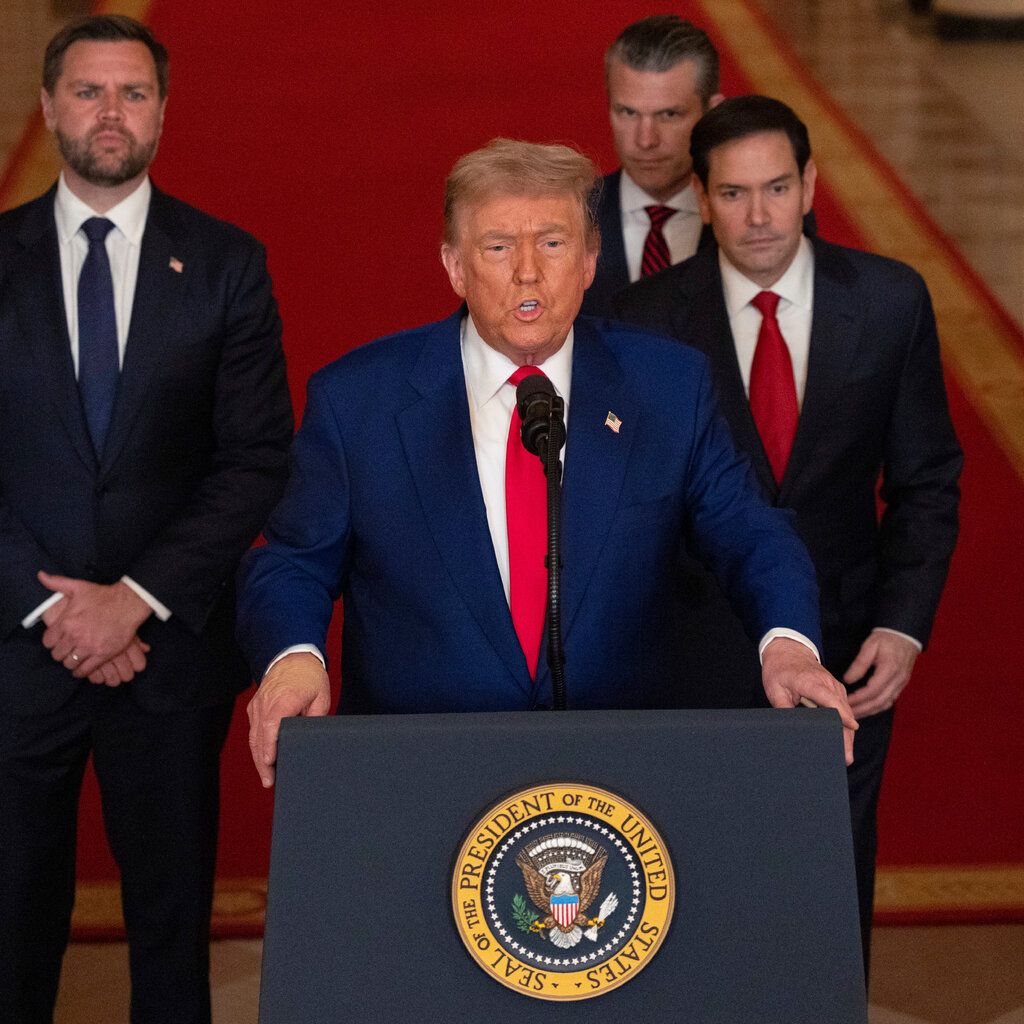
A fresh wave of geopolitical controversy has erupted after Donald Trump publicly declared that the United States should have a say in determining who becomes the next supreme leader of Iran. The
remarks came during a period of intense uncertainty in Tehran following the death of longtime leader Ali Khamenei, whose decades-long leadership shaped the country’s political identity and regional posture. Trump’s comments, which also included a blunt rejection of the possible succession of Khamenei’s son, have sparked fierce debate among diplomats, analysts, and political observers around the world.
According to Trump, the global consequences of Iran’s leadership transition are too significant for the United States to remain passive. Speaking to reporters while discussing the broader security situation in the Middle East, he argued that Washington must ensure that Iran does not fall under the control of what he described as “dangerous hardliners” who could intensify tensions with Western powers and neighboring states. Trump’s statement quickly reverberated across international media, raising questions about how far the United States might attempt to influence Iran’s internal political process.
The U.S. president was particularly critical of Mojtaba Khamenei, who has long been viewed by some analysts as a potential successor to his father. Mojtaba has maintained a relatively low public profile over the years but is believed to wield considerable influence within certain conservative religious networks and elements of Iran’s powerful security apparatus. His name has frequently surfaced in speculation about a future leadership transition, though Iranian authorities have never officially confirmed him as a candidate.
Trump dismissed the possibility outright. In unusually direct language, he said that the idea of Mojtaba Khamenei inheriting the position of supreme leader would be unacceptable from Washington’s perspective. He argued that Iran should avoid what he described as a dynastic transfer of power, insisting that the next leader should represent a break from the policies associated with the previous era. Trump framed his position as a call for stability and reform, claiming that a new direction in Tehran could reduce regional tensions and open the door to a different relationship with the international community.
The remarks immediately triggered reactions from analysts who note that Iran’s political system does not allow foreign governments any role in choosing its supreme leader. Under the country’s constitution, the responsibility for selecting the leader rests with the Assembly of Experts, a powerful body composed of senior clerics elected to oversee the highest religious authority of the state. Their deliberations traditionally occur behind closed doors, and decisions are often shaped by complex internal dynamics involving religious credentials, political alliances, and strategic considerations.
Iran’s leadership structure emerged after the Iranian Revolution, which replaced the monarchy with a theocratic system built around the concept of guardianship of the Islamic jurist. In this system, the supreme leader holds ultimate authority over the armed forces, major political institutions, and key aspects of foreign policy. As a result, the individual chosen to fill the role carries enormous influence not only within Iran but across the broader Middle East.
Trump’s call for American involvement in the succession process reflects a broader pattern of confrontation between Washington and Tehran that has shaped global politics for decades. Relations between the two countries have been marked by deep mistrust, economic sanctions, diplomatic standoffs, and occasional military escalations. The death of Ali Khamenei has therefore created a moment of uncertainty in which outside powers are closely watching the direction Iran may take next.
Some observers believe Trump’s statement was designed more as a strategic signal than a literal proposal. By publicly rejecting Mojtaba Khamenei as a successor, the U.S. president may be attempting to influence internal debates within Iran’s elite circles or send a message about the type of leadership Washington considers acceptable. Others, however, argue that such comments could have the opposite effect by strengthening nationalist sentiment inside Iran and encouraging hardline factions to rally against perceived foreign interference.
Iranian officials have historically been highly sensitive to outside attempts to shape their domestic politics. The legacy of foreign intervention in Iran—particularly the Cold War-era overthrow of Prime Minister Mohammad Mossadegh—remains deeply embedded in the country’s political memory. Because of this historical context, any suggestion that a foreign leader should help determine Iran’s leadership is likely to provoke strong reactions among both political elites and the broader public.
At the same time, the uncertainty surrounding Iran’s leadership transition has fueled speculation across the region. Several clerics and political figures have been mentioned by analysts as potential candidates to succeed Khamenei, though the final decision will ultimately be made through internal deliberations. Factors such as religious authority, loyalty to the revolutionary system, political alliances, and the ability to maintain unity among competing factions will all play a role in determining who emerges as the next leader.
For the United States and its allies, the stakes are considerable. Iran remains a central actor in Middle Eastern geopolitics, with influence extending across Iraq, Syria, Lebanon, and Yemen. The orientation of its future leadership could shape regional security dynamics, nuclear negotiations, and the broader balance of power in the Persian Gulf. As a result, governments around the world are watching developments in Tehran with intense interest.
Trump’s comments have also reignited debate about the broader question of foreign influence in leadership transitions. While major powers often attempt to shape political outcomes in other countries through diplomacy, economic pressure, or strategic alliances, direct public statements about selecting another nation’s leader are relatively rare. The bluntness of Trump’s remarks has therefore drawn attention not only for their content but also for the tone in which they were delivered.
Supporters of the president argue that the United States cannot ignore leadership changes in a country whose policies affect global energy markets, regional conflicts, and international security. From their perspective, expressing preferences about Iran’s future direction is part of a broader effort to prevent instability and reduce the likelihood of renewed confrontation. Critics, however, warn that such rhetoric risks escalating tensions and complicating already fragile diplomatic dynamics.
Inside Iran, the leadership transition will likely unfold according to internal procedures shaped by the country’s unique political structure. The Assembly of Experts is expected to consult extensively with senior clerics, political institutions, and influential power centers before announcing its final decision. Historically, these deliberations have been highly secretive, and the public often learns of the outcome only after consensus has been reached behind the scenes.
As the debate continues, Trump’s remarks have added another layer of complexity to an already sensitive moment in Middle Eastern politics. Whether the United States ultimately plays any meaningful role in influencing Iran’s leadership remains uncertain, but the discussion itself highlights the global significance of the transition. The choice of Iran’s next supreme leader will shape not only the country’s internal governance but also its approach to diplomacy, security, and regional influence for years to come.