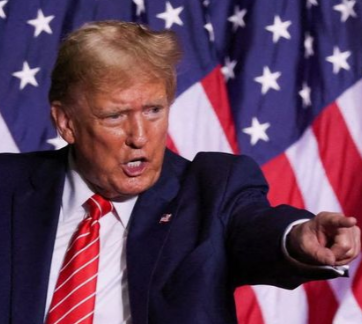
President Donald Trump has stated that he is not particularly concerned about whether Iran becomes a democratic state, emphasizing instead that his primary focus is ensuring that whoever leads the country in the future
maintains a respectful and cooperative relationship with the United States and its allies.
Speaking amid ongoing geopolitical tensions and uncertainty surrounding Iran’s leadership transition, Trump made it clear that the structure of Iran’s internal political system is not the central issue for Washington. According to him, the more important question is whether Iran’s leadership will adopt policies that avoid hostility toward the United States and contribute to broader regional stability.
Trump explained that governments around the world operate under different political systems, and that the United States must ultimately focus on its strategic interests rather than trying to reshape the internal governance structures of every nation. In his view, what matters most is that Iran’s leadership demonstrates a willingness to engage with the international community in a constructive manner rather than pursuing policies that escalate conflict.
The remarks come during a period of significant political uncertainty in Tehran following the death of longtime Supreme Leader Ali Khamenei, whose leadership defined Iran’s political direction for more than three decades. His passing has triggered an internal process within Iran’s political establishment to select a successor, a decision that could shape the country’s domestic policies and international relationships for years to come.
Within Iran’s political framework, the authority to choose the next supreme leader rests with the powerful Assembly of Experts, a body composed of senior clerics responsible for selecting and supervising the nation’s highest religious and political authority. The process typically unfolds behind closed doors, reflecting the sensitive nature of leadership transitions in the Islamic Republic.
Trump’s comments suggest that the United States is more concerned with the behavior and orientation of Iran’s future leadership than with the specific form of government that emerges. He indicated that Washington would be willing to engage with any leadership structure—religious or otherwise—provided that it does not pursue aggressive policies toward the United States or its partners in the region.
The U.S. president also stressed that long-term stability in the Middle East requires a leadership in Tehran that is capable of maintaining peaceful relations with neighboring countries. According to Trump, decades of hostility and confrontation have produced instability that has affected global energy markets, international security, and diplomatic relations across the region.
Analysts say Trump’s comments reflect a pragmatic approach to foreign policy in which strategic outcomes take precedence over ideological considerations. Rather than emphasizing democratic reform as a prerequisite for engagement, the focus appears to be on preventing further conflict and encouraging a leadership that is open to diplomacy.
This perspective has sparked debate among foreign policy experts. Some observers argue that prioritizing geopolitical stability over democratic principles could signal a shift in how the United States approaches political transitions abroad. They suggest that Washington’s willingness to work with different types of governments may increase if those governments align with American security interests.
Others, however, believe Trump’s remarks simply reflect the reality of international politics, where countries frequently cooperate with partners that operate under very different political systems. From this viewpoint, the central question is not the ideology of a government but whether its policies contribute to peace or confrontation.
The situation in Iran remains fluid as the country’s political and religious leadership continues to deliberate on the selection of a new supreme leader. The position is the most powerful office in the Iranian political structure, holding authority over the armed forces, major state institutions, and the country’s strategic foreign policy decisions.
Because of this influence, the identity of the next leader will have significant implications for the Middle East and the wider international community. Iran’s approach to diplomacy, regional alliances, and security issues could evolve depending on the priorities of the individual chosen to assume the role.
Trump’s comments have also drawn attention because they contrast with decades of American rhetoric that emphasized promoting democratic governance in parts of the Middle East. While previous administrations often framed foreign policy in terms of supporting democratic reforms, Trump’s statement suggests a more transactional approach centered on national interest and geopolitical stability.
Supporters of the president argue that this approach reflects practical realism. They contend that reducing tensions with Iran would benefit not only the United States but also the broader international community by lowering the risk of military confrontation and ensuring greater stability in global energy markets.
Critics, however, warn that focusing solely on strategic interests without encouraging political reform could undermine long-term efforts to promote democratic institutions in the region. They argue that sustainable peace often depends on governments that are accountable to their populations and open to political participation.
Despite the debate, Trump’s message was clear: the United States is primarily concerned with how Iran behaves on the global stage rather than the specific nature of its internal political system. According to the president, any future leadership in Tehran that chooses cooperation over confrontation could potentially open a new chapter in relations between the two countries.
As the leadership transition in Iran unfolds, governments around the world are watching closely. The decision made by Iran’s political and religious establishment will determine not only the country’s internal direction but also its approach to diplomacy, security, and regional influence.
For now, Trump’s remarks have added another dimension to the global conversation about Iran’s future. Whether the next leader continues the policies of the past or pursues a different course remains uncertain, but the outcome will undoubtedly shape the geopolitical landscape of the Middle East for years to come.