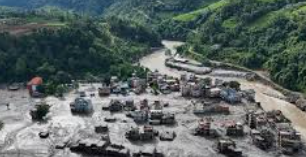
Nearly 1,500 people, including at least 800 foreign nationals, remain missing across Nepal and China’s Tibet after a section of a Himalayan glacier collapsed on Wednesday, triggering catastrophic flash floods that tore through towns and valleys, authorities said Thursday.
The disaster struck a rugged, high-altitude corridor linking Lhasa in Tibet with the Nepalese capital, Kathmandu, an area heavily traveled by trekkers and religious pilgrims. Police said the confirmed death toll, standing at more than 160, is expected to rise as search operations resume and more bodies are recovered.
In Nepal, 826 people are missing, including nearly 600 foreign nationals, according to police and tourism officials. Across the border, Chinese state media reported 558 people missing in Tibet’s Gyirong County, among them 260 foreign nationals.
The U.S. Geological Survey said the disaster began as seismic activity initially misread as a magnitude-4.4 earthquake, but was in fact energy released by the collapse of glacial rock and ice, which triggered a fast-moving debris flow into the river below. Chinese authorities have since flagged additional risk from a still-dammed lake upstream in Gyirong.
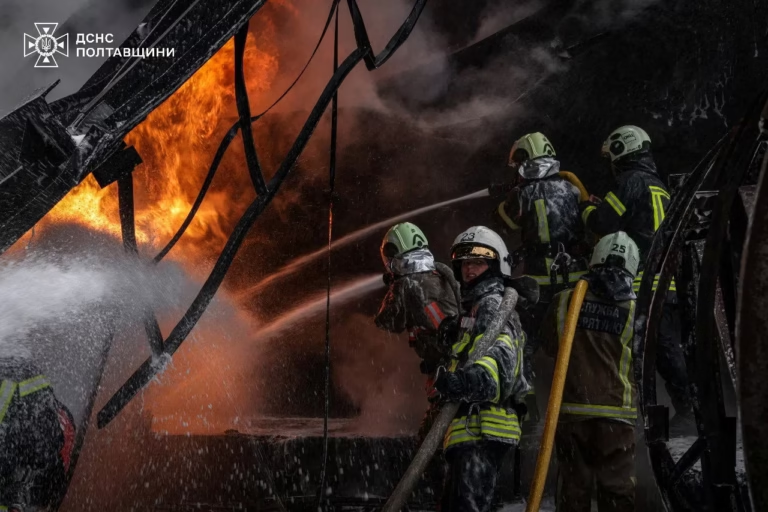
Rescue teams in Nepal have deployed helicopters, drones and search dogs, though high river levels, damaged roads and thick mud have hampered efforts to reach some of the worst-affected areas. On the Chinese side, deep sediment has similarly slowed access for rescue crews.
Many of those unaccounted for were pilgrims traveling to Kailash Mansarovar, a site in Tibet considered sacred by Hindus and Buddhists. International concern has mounted over the number of foreign visitors affected: Australia’s government said dozens of its citizens were missing, including members of two separate tour groups, while Ireland reported two of its nationals unaccounted for.
The United States said it was dispatching a disaster response adviser and providing $500,000 in assistance. United Nations Secretary-General António Guterres said UN teams and partners were sending supplies and personnel to support affected communities in Nepal. Canadian Prime Minister Mark Carney and Australian Prime Minister Anthony Albanese both offered condolences, with Albanese noting that limited resources in Nepal were complicating information-gathering on the ground.
.