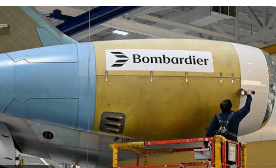
President Donald Trump said Monday he intends to block Canadian planemaker Bombardier from selling aircraft in the United States unless the company relocates manufacturing there, adding a fresh flashpoint to an already tense trade standoff with Ottawa just as new Canadian tariffs were set to take effect.
In a social media post, Trump said American buyers should stop supporting the company, arguing that Bombardier relies overwhelmingly on U.S. customers, corporate accounts, airport access and service networks for its business — pointing out that over half its revenue originates in the United States. He paired the complaint with a broader accusation that Canada has kept major American financial institutions and firms out of its domestic market. His message to the company was blunt: build in the U.S. or lose access to it.
How such a ban would actually be carried out is unclear. Bombardier already runs a Kansas-based facility that manufactures specialized military aircraft and employs about 3,500 people in the U.S., and roughly half of the company’s global fleet of more than 5,000 aircraft belongs to operators based domestically. Its supply chain spans plants in Canada, the U.S. and Mexico, and currently operates within the terms of the North American trade pact that Trump negotiated during his first administration.
This is not Trump’s first attempt to pressure the company. He made a nearly identical threat in January, floating decertification of Bombardier’s larger business jets along with a 50 percent tariff on Canadian-built aircraft, tied to his complaint that Canada was slow to approve competing jets from U.S. rival Gulfstream. Neither measure was ultimately implemented, and Canada cleared several Gulfstream models for its market the following month.
The renewed threat comes as trade relations between the two countries have deteriorated further. Talks broke down last month when Canada exited the negotiating table, prompting Washington to impose steep tariffs — roughly 50 percent — on close to $20 billion in Canadian exports. Prime Minister Mark Carney has said U.S. negotiators offered terms that were unreasonable, while American officials have suggested Carney backed away from a deal for domestic political reasons, a claim he rejects. Canada’s own retaliatory tariffs on a comparable value of American goods were due to take hold Tuesday.
In Quebec, Premier Christine Fréchette said she had contacted Bombardier’s chief executive, Éric Martel, to pledge the provincial government’s backing, adding that she would not escalate the conflict further and that no foreign government has the standing to dictate where Quebec-based companies choose to manufacture. Neither the Canadian prime minister’s office nor Bombardier had issued a public response by Monday evening.