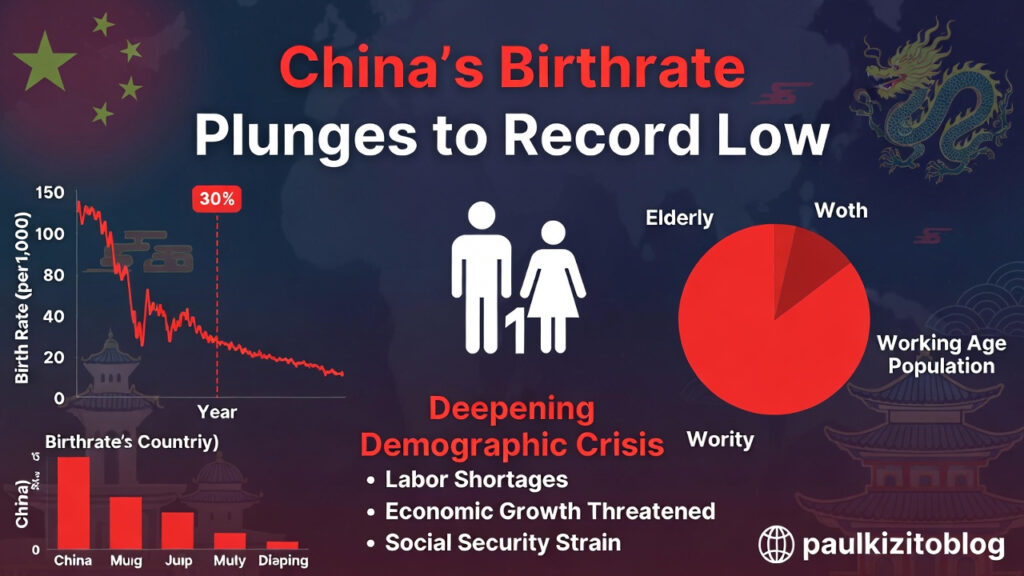
China’s demographic trajectory has taken a dramatic turn as the country’s birthrate falls to its lowest level since modern records began. The once rapidly growing population is now shrinking, raising serious concerns about China’s long-term economic stability, labor force, and social welfare systems.
Official data for 2025 shows that the number of births dropped sharply, with fewer than eight million babies born nationwide. This marks a significant decline from previous years and confirms a continuing trend rather than a temporary fluctuation. At the same time, deaths outnumbered births by a wide margin, accelerating the country’s population decline for the fourth consecutive year.
Population Decline Becomes Structural
China’s total population has now entered a sustained period of contraction. Demographers note that the country has reached a demographic turning point where low fertility, rising life expectancy, and an aging society are reshaping its future. Unlike earlier decades, when population growth fueled economic expansion, China must now adjust to a reality of slower growth driven by a shrinking workforce.
The decline is particularly striking given China’s past efforts to control population growth. Decades of strict family planning policies reduced birth rates dramatically, and their long-term effects continue to shape family choices today. Even after the removal of the one-child policy and the introduction of policies allowing two and later three children, birth numbers have failed to recover.
Why Fewer Chinese Are Having Children
Several factors are driving the collapse in births. Economic pressure is among the most significant. Housing prices, education costs, healthcare expenses, and childcare fees have risen faster than incomes in many urban areas. For young couples, the financial burden of raising a child is often viewed as overwhelming.
Social attitudes have also shifted. Younger generations increasingly prioritize career development, personal freedom, and financial independence. Marriage rates have declined, and couples are marrying later in life, reducing the window for childbearing. Women, in particular, face workplace challenges that discourage having children, including limited career flexibility and concerns about job security.
Government Efforts Struggle to Reverse the Trend
In response, Chinese authorities have rolled out a range of measures aimed at encouraging childbirth. These include financial incentives, tax benefits, extended maternity and parental leave, childcare subsidies, and public campaigns promoting family life. Some local governments have tied population targets to official performance evaluations.
However, experts say these measures have so far had limited impact. Incentives may ease some costs, but they do not address deeper concerns such as work-life balance, gender inequality in caregiving, and long-term economic uncertainty. As a result, many couples remain hesitant to start or expand families.
Economic and Social Consequences
China’s demographic decline carries profound economic implications. A smaller working-age population could reduce productivity and slow economic growth, placing pressure on industries that rely on abundant labor. At the same time, the rapidly aging population will increase demand for healthcare and pensions, straining public finances.
The shift also has global implications. As China’s population growth slows and reverses, its role in global manufacturing, consumption, and economic expansion may evolve. Other regions with younger populations may gain relative demographic advantages, altering global economic dynamics.
An Uncertain Demographic Future
China’s falling birthrate reflects deep structural changes that cannot be easily reversed. While policymakers continue to search for solutions, demographers caution that recovery is unlikely without sweeping reforms that make family life more affordable and compatible with modern lifestyles.
For now, the record-low birthrate marks a historic moment in China’s development — signaling the end of an era defined by rapid population growth and the beginning of a new chapter shaped by demographic decline and adaptation.