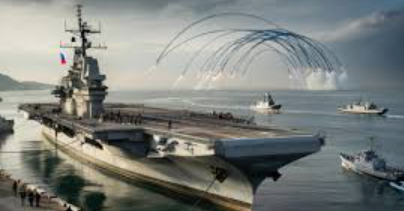
France’s decision to invest heavily in its next-generation aircraft carrier, known as the PANG (Porte-Avions
de Nouvelle Génération), represents far more than a routine military modernization programme. The project reflects a strategic calculation about power, independence, and influence in a rapidly changing global security environment where naval strength increasingly determines geopolitical relevance. While the price tag is expected to run into tens of billions of euros over its lifetime, French leaders view the investment as essential for preserving the country’s status as a major military power capable of acting independently on the world stage.
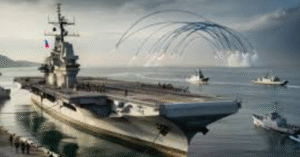
At the heart of the decision lies a simple reality: aircraft carriers remain one of the few tools that allow a nation to project power far beyond its borders without relying on foreign bases. France currently operates the Charles de Gaulle, its only aircraft carrier, which has served as the backbone of French naval aviation for more than two decades. However, aging infrastructure and evolving technological demands have made replacement unavoidable. The PANG is designed not merely as a successor but as a leap forward in capability, ensuring France maintains continuous carrier operations well into the second half of the century.
The new carrier is expected to be significantly larger and more advanced than its predecessor, powered by nuclear propulsion and capable of deploying next-generation fighter aircraft alongside drones and advanced surveillance systems. Nuclear propulsion offers a decisive advantage: extended deployment without frequent refueling, allowing France to sustain operations across vast oceans for prolonged periods. In an era where crises can emerge rapidly, endurance at sea translates directly into strategic flexibility.
France’s willingness to spend heavily on the project is driven largely by its commitment to strategic autonomy. Unlike many European nations that rely heavily on NATO partners, particularly the United States, France has long pursued the ability to conduct military operations independently when national interests require it. An aircraft carrier embodies that independence. It enables rapid response to crises in regions where France maintains historical, economic, or security ties, including parts of Africa, the Middle East, and the Indo-Pacific.
The Indo-Pacific region is especially central to France’s long-term planning. Often overlooked, France possesses overseas territories and millions of citizens across the Indian and Pacific Oceans, giving it one of the world’s largest exclusive economic zones. As competition intensifies among major powers in these waters, maintaining a credible naval presence becomes critical not only for defense but also for safeguarding trade routes, maritime resources, and political influence. The PANG carrier is intended to operate effectively in this environment, demonstrating that France remains a resident power rather than an external observer.
Another major reason behind the investment is technological leadership. The carrier will serve as a floating hub for future warfare technologies, integrating artificial intelligence, networked combat systems, and unmanned aircraft alongside traditional fighter jets. Modern naval warfare increasingly depends on data dominance as much as firepower, and the PANG is being designed to function as a command center capable of coordinating multinational operations. By building such a platform domestically, France also sustains its defense industrial base, supporting thousands of high-skill jobs and preserving expertise in nuclear engineering, shipbuilding, and aerospace innovation.
Economic considerations play a subtle but important role as well. Large defense projects often stimulate technological spillovers into civilian industries, from advanced materials to energy systems and digital communications. French policymakers argue that investment in complex defense platforms strengthens national innovation capacity while reinforcing supply chain resilience at a time when global dependencies have become strategic vulnerabilities.
Critics, however, question whether such massive spending is justified amid economic pressures and competing domestic priorities. Aircraft carriers are expensive not only to build but also to maintain and operate, requiring escort ships, aircraft fleets, and highly trained personnel. Some analysts argue that modern threats such as cyber warfare, hypersonic missiles, and autonomous weapons could make large naval platforms more vulnerable than in the past. Supporters counter that carriers continue to evolve and remain unmatched in their ability to deliver sustained air power without reliance on foreign infrastructure.
The debate ultimately reflects a broader question facing many nations: how to adapt military strategy to an uncertain future. For France, the answer appears to be maintaining versatility rather than choosing between traditional and emerging capabilities. The PANG is envisioned as a platform that can evolve over decades, incorporating new technologies as warfare changes. Its projected operational life into the 2080s means planners must anticipate not only current threats but those that may emerge generations from now.
There is also a political dimension to the project. France has long positioned itself as Europe’s leading military power following shifts in European defense dynamics. By committing to a next-generation carrier, Paris reinforces its leadership role within European security discussions and demonstrates that Europe can develop high-end military capabilities independently. The project may also encourage deeper defense cooperation among European allies seeking greater strategic balance within transatlantic partnerships.
Beyond strategy and politics, aircraft carriers carry symbolic weight. They represent national ambition, technological confidence, and global reach. When deployed, they signal commitment without immediate escalation, offering governments a flexible tool for diplomacy backed by credible force. In humanitarian crises, carriers can provide disaster relief, medical support, and evacuation capabilities, reinforcing their value beyond combat operations.
France’s investment in the PANG therefore reflects one overarching reason: maintaining freedom of action in an increasingly competitive world. As global power dynamics shift and security challenges multiply, nations capable of independent deployment retain greater influence over international outcomes. For French policymakers, the cost of losing that capability would be far higher than the price of building a new carrier.
The decision illustrates how modern defense planning extends far beyond military calculations. It blends economics, technology, diplomacy, and national identity into a single strategic choice. Whether viewed as a necessary safeguard or an ambitious gamble, the PANG aircraft carrier symbolizes France’s determination to remain a decisive actor in global affairs — a country prepared to invest heavily today to secure strategic relevance for decades to come.