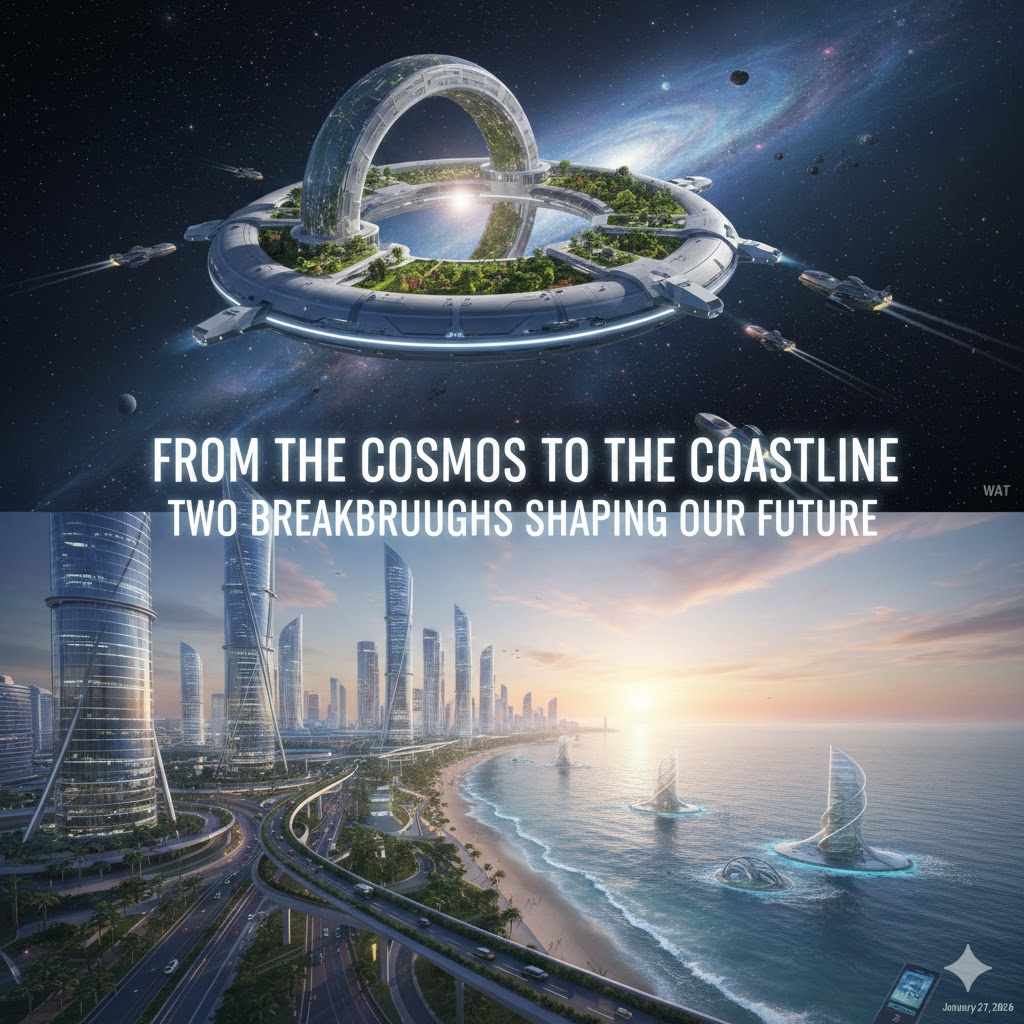
This week delivered progress on two very different scales: one that reshapes how we understand the universe itself, and another that strengthens how we power our lives here on Earth. Together, they highlight a broader trend—humanity’s growing ability to see farther, think bigger, and act more collaboratively.
Mapping the Invisible: A New View of Dark Matter
Scientists have released one of the most detailed maps yet of dark matter, the elusive substance believed to make up the majority of the universe’s mass. Though invisible and undetectable by conventional instruments, dark matter plays a fundamental role in shaping galaxies, bending light, and determining the large-scale structure of the cosmos.
The new map was created by observing how massive objects subtly distort the light traveling from distant galaxies, a phenomenon known as gravitational lensing. By analyzing these distortions across vast regions of space, researchers were able to infer where dark matter is concentrated and how it is distributed.
What makes this breakthrough especially important is precision. The clarity and scale of the data allow scientists to test long-standing theories about how the universe evolved after the Big Bang—and to spot discrepancies that could point to new physics. In short, the map doesn’t just show where dark matter is; it challenges us to rethink what we know about how the universe works.
Powering the Transition: Europe’s North Sea Wind Pact
Closer to home, European nations have reached a major agreement to expand offshore wind energy in the North Sea, one of the world’s most promising regions for renewable power. The pact aims to coordinate infrastructure, speed up project development, and strengthen energy security across the continent.
The market response was immediate. Renewable energy companies saw their share prices rise as investors interpreted the agreement as a strong signal of long-term policy commitment. For an industry that depends on large upfront investment and regulatory certainty, this kind of coordination matters.
Beyond economics, the pact carries strategic weight. By expanding clean energy capacity, European countries reduce dependence on fossil fuel imports, lower emissions, and increase resilience against energy shocks. Offshore wind, in particular, offers scale—able to power millions of homes while occupying minimal land.
A Common Thread: Seeing Long-Term Value
At first glance, a dark matter map and a wind energy agreement may seem unrelated. One peers billions of years into the past; the other plans decades into the future. Yet both reflect the same underlying shift: investment in long-term understanding and long-term solutions.
Scientific breakthroughs deepen our knowledge base, while energy cooperation turns that forward-looking mindset into tangible policy and infrastructure. Both require patience, coordination, and trust in collective effort.
Why It Matters
Progress doesn’t always arrive with fanfare. Sometimes it comes quietly—in better data, clearer maps, stronger agreements. But these are the building blocks of lasting change.
Whether it’s unlocking the secrets of the universe or building a cleaner, more secure energy system, this week’s developments remind us that meaningful advances often happen when curiosity meets collaboration.