French President Emmanuel Macron’s visit to Cyprus on March 9, 2026, marked a turning point in
Europe’s response to the escalating Iran conflict. His pledge to defend Cyprus after Iranian drones struck a British air base on the island was not just a symbolic gesture of solidarity—it was a declaration that Europe would no longer remain a passive observer as the war spilled beyond the Middle East. Macron’s words, backed by concrete military commitments, underscored France’s determination to position itself as the guarantor of European security in the Eastern Mediterranean.
The Setting: Cyprus Under Threat
Cyprus has long been a strategic outpost at the crossroads of Europe, Asia, and Africa. Its proximity to the Middle East makes it a vital hub for military operations, intelligence gathering, and energy routes. When Iranian-made drones targeted the British Akrotiri air base, the attack was more than a strike on a military installation—it was the first direct assault on European Union soil linked to the Iran war. For Cypriots, the incident was a chilling reminder of their vulnerability. For Europe, it was a wake-up call that the conflict could no longer be contained within the borders of Iran and Israel.
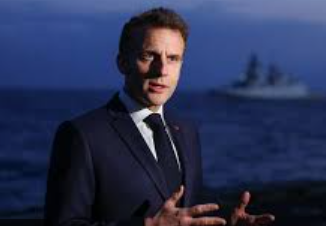
Macron’s arrival at the Andreas Papandreou Air Base in Paphos was carefully choreographed to send a message of reassurance. Standing alongside Cyprus President Nikos Christodoulides and Greek Prime Minister Kyriakos Mitsotakis, Macron declared that “Europe will protect Cyprus.” His words resonated deeply, not only with Cypriots but across the continent, where fears of escalation have grown steadily since the war began.
France Steps Forward
France has historically maintained a strong presence in the Mediterranean, but Macron’s announcement went further than previous commitments. He revealed that France would deploy additional warships, including the Charles de Gaulle aircraft carrier, along with a frigate, to the Eastern Mediterranean. Air-defense units would also be stationed in Cyprus to counter the threat of further drone attacks. These measures were designed to reassure Cyprus and demonstrate France’s readiness to act decisively.
The deployment of the Charles de Gaulle is particularly significant. As France’s flagship, the carrier symbolizes national strength and European resolve. Its presence in the region sends a clear signal to Iran and its allies that Europe is prepared to defend its territory and interests. Macron’s decision also reflects his broader vision of European strategic autonomy—a concept he has championed for years, arguing that Europe must be able to defend itself without relying solely on NATO or the United States.
The Broader Context
The Iran conflict has entered its second week, with Israel intensifying strikes and Iran retaliating through drone and missile attacks. The war has already destabilized the Middle East, but the strike on Cyprus marked a dangerous escalation. Analysts warn that the conflict could spread further, drawing in European states and threatening global energy supplies. Oil prices have surged to their highest single-day increase in six years, rattling markets worldwide and fueling fears of inflation.
Cyprus’s role in this unfolding drama is crucial. The island hosts British military bases that serve as key staging grounds for operations in the Middle East. Its location also makes it a vital link in Europe’s energy security, with pipelines and shipping routes passing nearby. Any disruption in Cyprus could have far-reaching consequences for Europe’s economy and security.
Macron’s Strategic Calculations
Macron’s pledge to defend Cyprus is not just about protecting one island—it is about shaping Europe’s response to a global crisis. By taking the lead, France positions itself as the driving force behind European defense. Macron’s actions also reflect his belief that Europe must act collectively to confront external threats. His visit to Cyprus, accompanied by the Greek prime minister, highlighted the importance of regional cooperation in the face of shared dangers.
Critics argue that France’s unilateral deployment risks escalating tensions with Iran. However, Macron’s supporters contend that inaction would be far more dangerous. By reinforcing Cyprus, France aims to deter further attacks and demonstrate that Europe will not tolerate aggression. Macron’s stance may also encourage other EU leaders to adopt stronger measures, paving the way for a coordinated European defense strategy.
Risks and Challenges
Despite Macron’s bold pledge, challenges remain. The deployment of French forces raises the risk of direct confrontation with Iran-backed militias or proxies. Any escalation could draw Europe deeper into the conflict, with unpredictable consequences. There are also questions about whether other EU states will follow France’s lead. While Macron has called for unity, divisions within the EU over foreign policy and defense remain a persistent obstacle.
Cyprus itself faces internal challenges. The island is divided between the internationally recognized Republic of Cyprus and the Turkish-controlled north. This division complicates efforts to present a united front and raises concerns about how external powers might exploit internal tensions. Macron’s visit focused on the Republic of Cyprus, but the broader geopolitical dynamics cannot be ignored.
European Solidarity and NATO
Macron’s pledge also has implications for NATO. While France is a key member of the alliance, Macron has often emphasized the need for Europe to develop its own defense capabilities. His actions in Cyprus reflect this vision, but they also align with NATO’s broader goals of protecting member states. The deployment of French forces complements existing NATO operations and underscores the importance of transatlantic cooperation in addressing global threats.
At the same time, Macron’s emphasis on European autonomy may spark debate within the alliance. Some argue that Europe should rely more heavily on NATO and the United States, while others support Macron’s call for greater independence. The situation in Cyprus may serve as a test case for how Europe balances these competing priorities.
Implications for the Future
Macron’s visit to Cyprus marks a turning point in Europe’s response to the Iran conflict. By pledging to defend Cyprus, France has signaled that Europe will not remain passive in the face of aggression. The deployment of warships and air-defense units demonstrates a willingness to act decisively, even at the risk of escalation. For Cyprus, Macron’s pledge offers reassurance and a sense of solidarity. For Europe, it represents a step toward greater unity and strategic autonomy.
The coming weeks will be critical. If Iran continues to target European territory, France’s actions may serve as a model for broader EU responses. If the conflict escalates further, Europe may be forced to take even stronger measures. Macron’s leadership will be tested, as will Europe’s ability to act collectively in the face of external threats.
Conclusion
French President Emmanuel Macron’s pledge to defend Cyprus after drone attacks is more than a symbolic gesture—it is a declaration of Europe’s resolve. By deploying warships and air-defense units, France has taken a bold step to protect EU territory and demonstrate solidarity with Cyprus. The move reflects Macron’s vision of European strategic autonomy and underscores the importance of collective defense in an increasingly unstable world.
Cyprus’s strategic location makes it a frontline state in Europe’s security landscape. The drone strike on its territory highlights the risks of the Iran conflict spilling into Europe and underscores the need for decisive action. Macron’s visit and pledge mark a turning point in Europe’s response, signaling that the continent is prepared to defend itself against external threats.
As the conflict unfolds, the risks of escalation remain high. But Macron’s actions may also pave the way for greater European unity and cooperation. His pledge to defend Cyprus is not just about one island—it is about shaping Europe’s role in a world where security challenges are increasingly global.