In a move that has heightened tensions across the Indo-Pacific, Russia and China carried out a coordinated air patrol near Japan’s airspace — a show of force that signals the deepening military partnership between the two powers and their shared willingness to challenge U.S. allies in the region.
The latest drill, involving strategic bombers, fighter escorts, and early-warning aircraft, triggered immediate responses from Japan and South Korea, both of which scrambled fighter jets to monitor and shadow the formation. While Moscow and Beijing described the patrol as part of their annual cooperation plan, the proximity of the operation to sensitive Japanese territory has raised alarms across Tokyo’s defense and diplomatic circles.
What Happened During the Drill
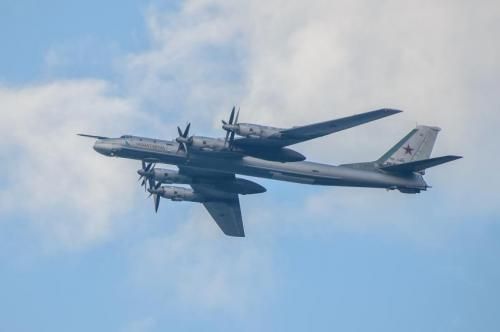
The joint patrol saw Russian Tu-95 strategic bombers flying in formation with Chinese H-6 bombers — both long-range aircraft capable of carrying cruise missiles. They were accompanied by Chinese fighter jets and a Russian airborne early-warning aircraft.
The formation flew a route between Okinawa’s main island and Miyako Island, an area long viewed by defense analysts as strategically sensitive due to its direct proximity to Japan’s southwestern islands and the Taiwan Strait.
Japan’s Defense Ministry said the flight path was “unusually close” to its territory, prompting a swift deployment of its Air Self-Defense Force. South Korea also scrambled jets after the aircraft briefly entered its air defense identification zone.
Why This Matters
1. Deepening Russia–China Military Cooperation
Joint military patrols between Moscow and Beijing have become more frequent, more complex, and more geographically ambitious. What once were symbolic drills are now highly coordinated operations that combine strategic bombers, fighter escorts, naval flotillas, and real-time data sharing.
2. A Test of Japan’s Resolve
The drills come at a time of increased friction between Japan and China, including recent radar-lock incidents and disputes over maritime activity near the Senkaku/Diaoyu Islands. For Japan, these operations are part of a wider pattern of intimidation and strategic pressure.
3. A Signal to the U.S. and Its Allies
The message is clear: China and Russia intend to project power in the western Pacific and complicate the security calculations of Washington, Tokyo, and Seoul. As U.S. alliances deepen in the region, the China-Russia axis appears determined to counterbalance.
Tokyo’s Reaction
Japanese officials condemned the drill, calling it a deliberate act of provocation at a time when regional tensions are already elevated. Japan emphasized that the aircraft did not enter its territorial airspace, but described the movement as “dangerously close” and “strategically purposeful.”
The latest actions coincide with Japan’s ongoing military modernization efforts, including expanded missile defense systems, greater cooperation with the United States, and renewed ties with South Korea.
The Bigger Geopolitical Picture
An Emerging Two-Bloc Indo-Pacific
The region is increasingly divided between U.S.-aligned nations — Japan, South Korea, Australia, the Philippines — and a tightening China-Russia strategic partnership. The recent drills underscore that military cooperation between Beijing and Moscow is no longer confined to symbolic gestures but has evolved into active, coordinated power projection.
Growing Risks of Miscalculation
More frequent air and naval encounters increase the risk of accidental escalation. Radar-lock incidents, near-misses, and aggressive maneuvers could quickly spiral into diplomatic crises or military confrontation.
Pressure on Regional Defense Strategies
Countries in the region may accelerate defense spending, strengthen alliances, and re-orient military posture in response to the new reality of China-Russia coordination.
What to Watch Next
- Will China and Russia expand the drills into naval or missile exercises in the same area?
- How will the U.S. respond, especially with joint drills of its own planned with Japan?
- Will Japan revise its defense guidelines to authorize quicker or stronger responses to airspace challenges?
- Could Southeast Asian nations be drawn into the broader geopolitical standoff?
📚 References
- “Russian bombers join Chinese air patrol near Japan as Tokyo-Beijing tie strains” — Reuters Reuters+2Geo News+2
- “Chinese and Russian bombers hold joint drill near Japan in ‘show of force’” — The Japan Times The Japan Times
- “China, Russia Bombers Fly Together off Japan’s Shikoku for 1st Time” — Nippon.com (via Jiji Press) Nippon.com
- “South Korea, Japan scramble fighter jets as Chinese, Russian bombers run joint Pacific patrol” — The Moscow Times The Moscow Times
- “China, Russia conduct air patrol in Asia-Pacific Region” — TASS (Russian Defence Ministry statement) TASS
- “Fixed-wing: China–Russia conduct joint bomber patrol near Japan” — FlightGlobal summary of the patrol over Miyako Strait and western Pacific airspace. Flight Global