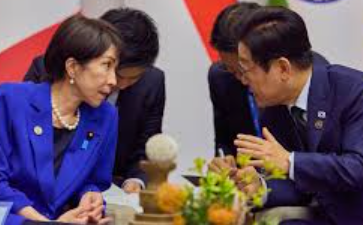
South Korea is preparing for a closely watched summit between President Lee Jae-Myung and Japanese Prime Minister Sanae Takaichi, a meeting that follows Lee’s recent high-level talks with China and underscores Seoul’s effort to steady relations among Northeast Asia’s key powers.
The upcoming meeting is being framed by South Korean officials as part of a broader diplomatic push to reduce friction, rebuild trust, and manage regional tensions at a time of growing strategic uncertainty across East Asia.
A delicate sequence of diplomacy
President Lee’s decision to meet Japan’s leader shortly after engaging China is being interpreted as a deliberate signal: Seoul intends to avoid being pulled too far in any single direction as competition between major powers intensifies.
South Korea sits at the center of several overlapping fault lines — U.S.–China rivalry, tensions on the Korean Peninsula, and historically strained ties with Japan. By sequencing talks with Beijing and Tokyo, Lee appears to be positioning South Korea as a stabilizing intermediary, rather than a passive participant in regional rivalry.
Officials in Seoul say the summit with Japan will focus on restoring consistent communication and preventing disputes from escalating into prolonged diplomatic standoffs.
Repairing a fragile Seoul–Tokyo relationship
Relations between South Korea and Japan have improved in recent years but remain vulnerable, shaped by unresolved historical grievances, trade disputes, and domestic political pressures on both sides.
The Lee–Takaichi meeting is expected to address:
- Economic and technology cooperation
- Security coordination, particularly regarding North Korea
- Historical issues that continue to inflame public opinion
While neither side is expected to announce sweeping agreements, diplomats suggest the goal is predictability rather than breakthroughs.
Trilateral stability in focus
Beyond bilateral ties, the summit carries broader regional implications. Analysts say South Korea is increasingly aware that strained relations among Seoul, Tokyo, and Beijing only deepen instability at a time when military activity, supply-chain competition, and nationalist rhetoric are on the rise.
By engaging both China and Japan in close succession, Lee’s administration appears to be testing whether pragmatic diplomacy can coexist with strategic competition.
“Seoul is signaling that dialogue itself is a security asset,” one regional analyst said. “In this environment, even managed disagreement is preferable to silence.”
Managing tensions without choosing sides
South Korean officials have emphasized that the president’s diplomatic outreach does not represent a shift away from alliances or values, but rather an effort to keep communication channels open across competing blocs.
For President Lee, the Japan summit is a chance to demonstrate that South Korea can pursue strategic balance — maintaining security partnerships while also engaging neighboring powers whose cooperation remains essential to regional stability.
As regional tensions continue to simmer, expectations for the meeting remain measured. Still, the symbolism of sustained dialogue may prove as important as any concrete outcome.