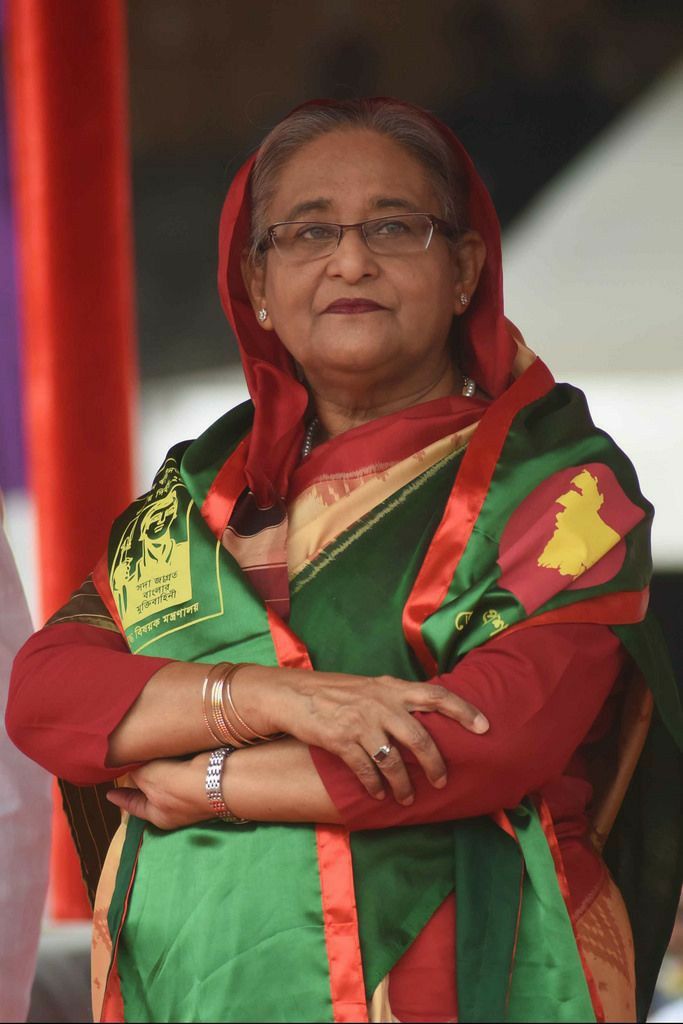
In a stunning twist that has shaken South Asia and reverberated across global political and human-rights
circles, Bangladesh’s former Prime Minister Sheikh Hasina, once hailed as the “Mother of Humanity,” has now been sentenced to death in absentia by a special tribunal for crimes against humanity linked to last year’s brutal crackdown on student protesters.
This development marks one of the most dramatic political reversals in modern Asian history — the downfall of a leader who dominated Bangladesh’s political landscape for more than 15 years and held near-absolute control over state institutions, the military, the police, and the ruling Awami League.
What follows is a deep, narrative-driven, long-form story you can publish on your blog — richly detailed, emotionally compelling, and structured for maximum reader engagement.
A NATION SET ON FIRE: THE STUDENT REVOLT THAT CHANGED EVERYTHING
Bangladesh, a nation of over 170 million people, has always been politically charged. But nothing in its past prepared it for the unprecedented student uprising that erupted in mid-2024.
It began innocently — like many revolutions do — with a dispute about the job quota system, which students argued unfairly reserved government positions for favored groups. But the issue quickly snowballed into something far larger: a cry for justice, transparency, and freedom from decades of political repression.
University campuses from Dhaka to Chittagong became warzones.
Student leaders organized mass marches, human chains, sit-ins, and vigils.
The momentum grew daily, and by July 2024, millions of youths filled the streets.
Sheikh Hasina, then the longest-serving PM in the country’s history, miscalculated. Instead of dialogue, she responded with force.
THE NIGHT THE SKIES TURNED BLACK
Witnesses recall the night of July 28, 2024, as one of the darkest in Bangladesh’s democratic history. As student demonstrators held a peaceful vigil at Dhaka University’s historic Shaheed Minar, police and paramilitary units descended without warning.
Tear gas.
Rubber bullets.
Live bullets.
Sound grenades.
Armored vehicles.
Videos circulated online showing:
- Students dragged by the hair
- Teachers shielding their students
- Young protesters collapsing
- Police firing into crowds
- Bodies on pavements
- Ambulances blocked from entering protest zones
Within 48 hours, the death toll had climbed into the hundreds. Within a week, some international estimates put the number of dead at over 1,400 — a staggering figure for a democratic country.
At the center of the storm was Sheikh Hasina, accused of giving direct orders to use whatever force necessary to “restore order.”
THE COLLAPSE OF A TITAN
By early August 2024, Bangladesh was no longer governable.
Police officers defected.
Student groups armed themselves with makeshift shields.
Thousands camped outside government buildings.
International pressure mounted.
The final blow came when several military commanders refused to continue the crackdown. The government structure crumbled, and Sheikh Hasina, sensing the end, fled to India in a convoy escorted by loyalists.
For a woman long seen as invincible — who survived assassination attempts, ousted generals, and controlled every major institution — it was a humiliating exit.
THE TRIBUNAL THAT REWRITES HISTORY
Fast-forward to 2025.
The new interim government formed the International Crimes Tribunal, modeled after previous tribunals in the country but with broader powers. Their mandate:
Investigate the events of July–August 2024 and determine accountability at the highest levels.
The evidence was overwhelming:
- Recorded phone calls
- Internal directives
- Witness testimonies
- Police logs
- Video footage
- Autopsy reports
- Confessions of junior officers
Prosecutors argued that Sheikh Hasina had direct knowledge and gave explicit consent for the deadly suppression of unarmed students.
In early 2025, the tribunal issued what many consider the most consequential ruling in Bangladesh’s history:
Sheikh Hasina — sentenced to death for crimes against humanity.
Former Home Minister Asaduzzaman Khan — also sentenced to death.
The verdict was delivered to a packed courtroom and broadcast live across the nation.
Some wept with relief.
Others cried in disbelief.
Many remained silent, numbed by the gravity of it all.
FIRE ON THE STREETS: BANGLADESH AFTER THE VERDICT
No sooner had the ruling been announced than the streets erupted again.
This time it was not students alone — it was the entire country.
Pro-Awami League loyalists clashed with security forces.
Protesters torched properties connected to Hasina’s family.
Videos emerged of crowds attempting to storm the house of Sheikh Mujibur Rahman — Hasina’s father and revered independence hero.
Police responded with batons and tear gas as they tried to contain the unrest. The nation teetered on the edge of chaos once more.
HASINA SPEAKS FROM EXILE
From her undisclosed refuge in India, Hasina released a video message calling the sentence:
“A political assassination disguised as justice.”
She denied all charges, accused the tribunal of bias, and insisted she had acted to “preserve national stability.” But her words carried far less weight now. The Bangladeshi public — especially the youth — had already passed their own verdict.
A COUNTRY AT A CROSSROADS
Bangladesh is now standing on the brink of choosing what kind of nation it wants to be.
Will this sentencing mark:
- A new beginning — with accountability, justice, and democracy?
OR - A new era of instability — with political revenge cycles and deeper polarization?
Only time will tell. But one thing is certain:
The once-unquestionable dominance of Sheikh Hasina has come to an end.
Her legacy, once burnished by economic growth and development, is now stained by one of the deadliest civilian crackdowns in modern South Asian history.
CONCLUSION: THE END OF AN ERA — AND THE BIRTH OF ANOTHER
This saga is not just about a leader falling.
It is about a nation rising.
The students who spark revolutions often do not realize the power they hold — until history records their bravery. And in Bangladesh, 2024–2025 will forever be remembered as the year when the youth toppled a political giant.
The death sentence is not merely a legal decision.
It is a message.
A message that no one — not even a Prime Minister — is above accountability.
A message that the blood of students cannot be forgotten.
A message that democracy, though fragile, still breathes in Bangladesh.
History has turned its page.
The world is watching what comes next.