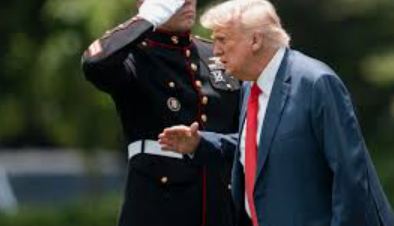
United States President Donald Trump has issued a stern public warning to the Iranian government over the treatment and safety of protesters, reigniting long-standing tensions between Washington and Tehran and drawing renewed international attention to Iran’s domestic unrest and human-rights record.
In a statement circulated through his political communication channels, Trump cautioned Iranian authorities against the use of lethal force or mass repression against demonstrators, asserting that the world was “watching closely” and that abuses against civilians would not be forgotten. The remarks came amid renewed protests in several Iranian cities, reportedly triggered by economic hardship, inflationary pressures, and long-standing grievances over political freedoms.
Although Trump currently holds no executive office, his intervention carries weight given his enduring influence within U.S. politics and his administration’s legacy of confrontational policies toward Iran. His warning was framed not merely as moral condemnation but as a geopolitical signal, suggesting that future U.S. leadership could revisit punitive measures should Tehran escalate its response to dissent.
Protests and the Iranian State Response
Iran has experienced periodic waves of protests over the past decade, often sparked by economic stress but sustained by broader frustrations with governance, corruption, and social restrictions. Demonstrations have historically been met with heavy security responses, including arrests, internet shutdowns, and, in some instances, lethal force.
Reports emerging from inside the country indicate heightened security deployments around major urban centers, with authorities emphasizing the need to maintain public order and accusing foreign actors of exploiting domestic grievances. Iranian officials have repeatedly rejected allegations of systemic abuse, insisting that law-enforcement actions are lawful and necessary to prevent instability.
Trump’s warning challenges this narrative directly. By focusing on the “safety of protesters,” he places the emphasis on civilian protection rather than state security, aligning his message with broader international human-rights discourse.
Trump’s Iran Record and Strategic Messaging
During his presidency, Trump pursued what he described as a “maximum pressure” campaign against Iran, withdrawing the United States from the 2015 nuclear agreement and reimposing sweeping economic sanctions. His administration argued that economic leverage was necessary to curb Iran’s regional influence and nuclear ambitions, while critics contended that sanctions exacerbated civilian suffering without producing meaningful reform.
The latest warning reflects continuity rather than novelty in Trump’s approach. By publicly addressing Iran’s leadership, he reinforces his image as a hardline actor unwilling to separate domestic repression from international legitimacy. Analysts note that such statements also resonate with Trump’s political base, which views Iran as a principal adversary of U.S. interests.
At the same time, the language of protester protection allows Trump to frame his position in moral terms, broadening its appeal beyond strictly partisan lines and situating it within global concerns about authoritarian governance.
Tehran’s Likely Reaction
Iranian officials have historically dismissed external warnings as interference in internal affairs, and Trump’s statement is unlikely to alter that stance. State-aligned media have often portrayed U.S. commentary on protests as hypocritical, pointing to domestic unrest and policing controversies within the United States itself.
Nevertheless, international pressure can carry indirect consequences. Public warnings by high-profile figures contribute to diplomatic scrutiny, influence global media coverage, and may affect the calculations of allies and partners considering engagement with Tehran. Even absent immediate policy shifts, such statements can shape the broader environment in which Iran operates.
International Implications
Trump’s remarks arrive at a moment of global uncertainty, with Middle Eastern geopolitics shaped by ongoing conflicts, fragile negotiations, and shifting alliances. Iran’s internal stability is closely watched by regional actors, many of whom fear that prolonged unrest could spill across borders or alter the balance of power.
Human-rights organizations have echoed calls for restraint, urging Iranian authorities to respect freedom of expression and assembly. European governments, while more cautious in tone, have similarly emphasized the need to avoid violence against civilians.
In this context, Trump’s warning adds a sharper, more confrontational voice to an already complex international chorus. Whether it escalates tensions or merely reinforces existing divisions remains to be seen.
Looking Ahead
The immediate impact of Trump’s statement will depend largely on developments within Iran. Should protests intensify and repression increase, his warning may be cited as an early signal of potential future consequences. If tensions subside, the statement may fade into the background of ongoing rhetorical exchanges between Tehran and its critics.
What is clear, however, is that Iran’s domestic challenges continue to reverberate beyond its borders. The safety of protesters has become not only a human-rights concern but also a geopolitical issue, one capable of drawing in foreign leaders long after they leave office.
For Trump, the warning serves multiple purposes: reaffirming his hardline credentials, shaping the narrative around Iran, and positioning himself as a vocal defender of popular dissent against authoritarian rule. For Iran, it underscores the enduring reality that internal governance decisions are inseparable from international perception and pressure.
As protests evolve and global reactions accumulate, the question is not merely how Iran responds to its citizens, but how those responses will reshape its standing in an increasingly scrutinized world.
#paulkizitoblog