A newly announced ceasefire between the United States and Iran has offered a measure of relief amid rising tensions—but Washington has made one point unmistakably clear: Lebanon is not part of the deal.
The clarification, confirmed by Donald Trump and senior U.S. officials, highlights both the narrow scope of the agreement and the broader challenges of containing conflict in an increasingly fragmented Middle East.
A Limited Agreement by Design
According to the White House, the ceasefire applies strictly to direct hostilities involving Iran. It does not extend to conflicts involving allied or proxy forces operating elsewhere in the region.
This distinction is critical. While the agreement may reduce the risk of direct confrontation between Washington and Tehran, it leaves other active battlegrounds—most notably Lebanon—outside its framework.
In effect, the ceasefire is less a comprehensive peace arrangement and more a targeted de-escalation mechanism.
The Lebanon Exception
Lebanon’s exclusion reflects the complicated role of Hezbollah, the Iran-backed group deeply embedded in the country’s political and military landscape.
For U.S. policymakers, clashes involving Hezbollah—particularly its ongoing confrontation with Israel—are treated as a separate track. They are not considered part of the direct U.S.–Iran conflict, even though they are closely linked in practice.
This separation may make diplomatic sense on paper, but on the ground it creates a fragmented reality:
a ceasefire in one arena, and escalation in another.
Confusion and Competing Narratives
The announcement has also exposed gaps in communication. Early signals from some international actors suggested a broader ceasefire might be in place, fueling expectations that Lebanon would be included.
Those expectations were quickly tempered by U.S. officials, who described any broader interpretation as a misunderstanding rather than a shift in policy.
The episode underscores a recurring challenge in modern diplomacy: agreements involving multiple actors often mean different things to different parties.
Violence Continues
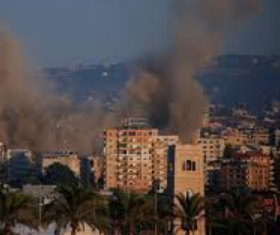
While the ceasefire may ease tensions between Washington and Tehran, it has done little to slow violence in Lebanon. Cross-border strikes and retaliatory attacks continue, raising the risk of further escalation.
This ongoing instability highlights a central weakness of limited agreements—they can reduce risk at one level while leaving other flashpoints dangerously exposed.
A Fragmented Path to Stability
The exclusion of Lebanon reveals a deeper structural issue in regional diplomacy. Middle Eastern conflicts are rarely isolated; they are interconnected through alliances, proxy networks, and overlapping interests.
Attempting to compartmentalize them may produce short-term gains, but it also risks undermining long-term stability.
For the United States, the ceasefire represents a strategic pause. For the region, however, it is a reminder that partial peace can coexist with persistent conflict.
The Bigger Picture
The U.S.–Iran ceasefire is a step toward de-escalation—but not a solution to the broader crisis.
By leaving Lebanon outside the agreement, Washington has drawn a line between direct confrontation and proxy warfare. Whether that line can hold remains uncertain.
In today’s Middle East, the challenge is no longer just ending wars—it is managing a landscape where multiple conflicts unfold simultaneously, each with its own rules, actors, and consequences.