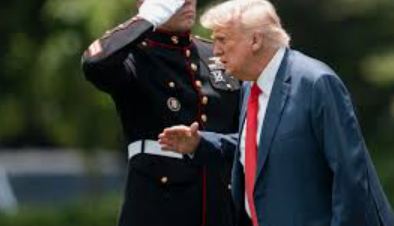
The fragile balance of transatlantic relations was jolted this week after U.S. President Donald Trump openly suggested that the use of American military force remains “always an option” in efforts to secure Greenland, a vast Arctic territory that belongs to the Kingdom of Denmark. The remark, delivered through official White House messaging, has triggered shock across Europe, provoked firm resistance from Denmark and Greenland’s own leaders, and reopened a debate many thought had been permanently shelved: can territorial ambition still be openly asserted in the 21st century?
While the White House insists that diplomacy remains the preferred path, the explicit reference to military power has cast a long shadow over NATO unity and underscored how intensifying global competition is reshaping even the most stable alliances.
A Controversial Idea Returns—With Sharper Edges
Donald Trump’s interest in Greenland is not new. During his first presidency, he famously floated the idea of purchasing the Arctic island, an idea that was swiftly rejected by Denmark and ridiculed in parts of Europe. At the time, the proposal was largely treated as an unconventional diplomatic misstep.
This time, however, the tone is markedly different.
In recent comments attributed to the president and amplified by senior administration officials, Trump framed Greenland not merely as an attractive strategic asset, but as a national security priority. In that context, the White House stated that all options remain on the table, including the use of military force, should U.S. interests require it.
That language alone has been enough to send tremors through diplomatic circles. For the first time in decades, a U.S. president has publicly entertained the idea of force against territory belonging to a close ally—an ally that is also a founding member of NATO.
Why Greenland Matters More Than Ever
Greenland may be sparsely populated, but its strategic significance is enormous. Sitting between North America and Europe, the island occupies a critical position in the Arctic, a region undergoing rapid transformation due to climate change.
As ice melts, new shipping routes are emerging, shortening travel times between continents and increasing commercial and military traffic. At the same time, the Arctic is believed to hold vast untapped reserves of oil, gas, and rare earth minerals—resources essential to modern economies and advanced military systems.
The United States already maintains a military presence on Greenland, most notably at Pituffik Space Base, a key installation for missile warning systems, space surveillance, and Arctic defense. For decades, this presence has been governed by agreements with Denmark and accepted within the framework of NATO cooperation.
Trump’s renewed push goes far beyond those arrangements. Supporters of the idea within U.S. strategic circles argue that outright control of Greenland would permanently secure American dominance in the Arctic and block rivals—particularly Russia and China—from gaining influence in the region.
Russia, China, and the Arctic Chessboard
At the heart of Washington’s calculations is growing anxiety over rival powers.
Russia has significantly expanded its Arctic military footprint, reopening old Soviet-era bases, deploying advanced air defense systems, and increasing patrols along its northern coast. Moscow views the Arctic as central to its future economic and military power.
China, meanwhile, has declared itself a “near-Arctic state” and has pursued investments in polar research, shipping, and resource extraction. Though its presence in Greenland has been limited, Beijing’s long-term ambitions in the Arctic have raised red flags in Washington.
From this perspective, Greenland is seen not as a remote territory, but as a linchpin in a broader global contest. Trump’s supporters argue that hesitation now could leave the United States strategically disadvantaged for decades.
Critics, however, say such reasoning dangerously conflates strategic competition with territorial entitlement.
Europe Reacts With Outrage and Unity
The reaction from Europe was swift and unusually unified.
Denmark categorically rejected the suggestion that Greenland could be acquired by force or coercion, emphasizing that the island’s status is non-negotiable. Danish leaders warned that any attempt to use military pressure would represent an unprecedented breach of trust between allies.
Other European governments echoed that stance. France, Germany, the United Kingdom, and several other NATO members reaffirmed their commitment to the principle that borders and sovereignty cannot be altered by threat or force—even when strategic interests are involved.
Privately, European diplomats have expressed alarm that such rhetoric could weaken NATO at a time when unity is already strained by conflicts in Ukraine, the Middle East, and rising tensions in Asia. Publicly, they have sought to keep the focus on dialogue and restraint.
Greenland’s Voice: “Not for Sale, Not for Threat”
Perhaps the most important response has come from Greenland itself.
Greenland is a self-governing territory with its own parliament and prime minister, though Denmark retains control over defense and foreign policy. For years, Greenlandic leaders have emphasized their right to self-determination and their desire to chart an independent future, potentially including eventual full independence.
In response to Trump’s remarks, Greenland’s government made its position unmistakably clear: the island is not for sale, not for seizure, and not a bargaining chip in great-power politics.
Local leaders described the idea of military pressure as deeply offensive, arguing that it disregards the rights, culture, and democratic will of Greenland’s people. Many Greenlanders fear becoming collateral damage in a geopolitical struggle they did not choose.
NATO Under Strain
The implications for NATO are profound.
The alliance is built on the principle of collective defense—an attack on one member is considered an attack on all. While no one suggests an actual U.S. invasion of Greenland is imminent, the mere suggestion that force is an option against a NATO ally’s territory raises uncomfortable questions.
How would NATO respond if one member threatened another? What happens to alliance credibility if its most powerful member openly challenges the sovereignty of a smaller one?
These are questions NATO was never designed to answer, and alliance officials are keen to prevent rhetoric from turning into a crisis of confidence.
Domestic Debate in the United States
Within the United States, reactions have been mixed.
Some lawmakers, particularly those aligned with Trump’s “America First” worldview, defend the president’s blunt approach. They argue that traditional diplomacy has failed to keep pace with a harsher global environment and that strategic clarity—even when uncomfortable—is preferable to ambiguity.
Others, including members of both parties, have pushed back strongly. Critics warn that threatening military action against allies undermines U.S. moral authority, weakens alliances, and hands propaganda victories to adversaries.
Legal scholars have also pointed out that any attempt to seize Greenland by force would violate international law and long-standing norms the United States has historically championed.
Rhetoric or Real Policy?
A key question remains: is this rhetoric designed to shock and pressure, or does it signal a genuine policy direction?
Some analysts believe Trump’s comments are intended to force negotiations—perhaps to secure expanded U.S. military rights, long-term leases, or exclusive access to resources—rather than to pave the way for annexation.
Others caution that repeated normalization of such language lowers the threshold for actions once considered unthinkable. In an era of heightened global tension, words themselves can reshape expectations and behavior.
A World Watching Closely
The controversy over Greenland is about far more than one island. It reflects a world in which strategic competition is eroding long-held assumptions about sovereignty, alliances, and restraint.
For smaller states and territories, the episode is unsettling: if even NATO members are not immune from coercive rhetoric, what protections truly exist in an age of great-power rivalry?
For the United States, the stakes are equally high. How Washington handles this moment will shape perceptions of its leadership—not just in Europe, but across the globe.
Conclusion: A Dangerous Precedent
Greenland’s icy landscapes may seem distant from the world’s major capitals, but the debate surrounding its future has struck at the core of the international order.
By declaring that military force is “always an option,” President Trump has reignited fears of a return to power politics defined by dominance rather than cooperation. Whether this moment becomes a footnote in diplomatic history or a turning point in transatlantic relations will depend on what comes next.
For now, one thing is clear: in a rapidly changing world, even the most remote places can become flashpoints—and even the strongest alliances can be tested by a single sentence.