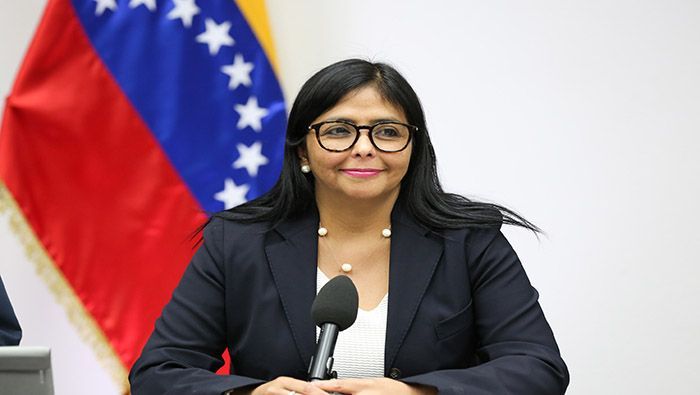
Venezuela’s armed forces have formally recognized Vice President Delcy Rodríguez as the country’s acting leader following the sudden capture of President Nicolás Maduro, a move that signals an effort by the state’s remaining power structures to preserve institutional continuity amid unprecedented political upheaval.
The announcement, delivered through a statement attributed to senior military commanders, comes at a moment of extraordinary uncertainty for the South American nation. With Maduro now in U.S. custody after a dramatic operation that ended his rule, Venezuela’s political system has been forced into rapid recalibration, even as competing claims of legitimacy emerge both domestically and internationally.
By backing Rodríguez, the military appears to be prioritizing stability and internal command cohesion over ideological confrontation. Analysts say the decision reflects a calculation that avoiding a leadership vacuum is essential to preventing chaos within the ranks and across the country.
A Controlled Transition by the Armed Forces
Rodríguez, a longtime Maduro ally and one of the most powerful figures within the previous administration, was presented by military leaders as the constitutional successor empowered to maintain state functions during what they described as an “exceptional national circumstance.”
In their statement, commanders emphasized the need to protect territorial integrity, maintain public order, and ensure the continued operation of essential services. The language was notably measured, avoiding direct escalation toward the United States while firmly rejecting the idea that Venezuela is without leadership.
This posture suggests that the military is attempting to manage a narrow path: asserting sovereignty and continuity while avoiding internal fragmentation or direct confrontation that could worsen an already fragile situation.
Rodríguez Steps Into a Volatile Role
As acting leader, Rodríguez inherits a deeply divided country facing economic exhaustion, political polarization, and social fatigue. Her immediate authority rests less on popular mandate and more on the backing of the armed forces, a reality that will shape both her domestic and international standing.
Rodríguez addressed the nation shortly after the military’s declaration, calling for calm and unity while denouncing what she described as foreign interference. At the same time, she pledged to keep government institutions functioning and to prevent further instability.
Whether her leadership will be temporary or evolve into a longer-term arrangement remains unclear. What is evident, however, is that her position is being defined under extraordinary pressure—from international scrutiny abroad and public expectation at home.
Military Loyalty as the Decisive Factor
The Venezuelan military has long been the ultimate arbiter of political power in the country. Its swift recognition of Rodríguez underscores the institution’s desire to remain the central stabilizing force during transition, rather than allowing authority to fracture among rival political actors.
Observers note that the military’s decision does not necessarily signal ideological endorsement, but rather institutional self-preservation. With Maduro removed and opposition forces emboldened, maintaining a clear chain of command has become a strategic priority.
This move may also be intended to strengthen Caracas’s negotiating position in any future international dialogue by demonstrating that the state apparatus has not collapsed.
International Implications
The recognition of Rodríguez complicates the international response to Maduro’s capture. While the United States has framed the operation as a step toward political transition, Washington has not formally acknowledged Rodríguez’s authority, instead emphasizing the need for a broader restructuring process leading to elections.
Other governments have responded cautiously, calling for restraint and dialogue while monitoring whether Rodríguez’s leadership gains practical legitimacy beyond military endorsement.
Legal experts point out that Venezuela’s constitutional framework offers ambiguous guidance in such circumstances, particularly when a sitting president is removed through external action rather than internal legal process. This ambiguity is likely to fuel ongoing diplomatic and legal debates.
Public Reaction at Home
Inside Venezuela, public reaction has been mixed. In some areas, citizens have expressed cautious relief that the sudden power shift has not immediately resulted in disorder. In others, skepticism remains high, with many questioning whether a change in leadership figures will translate into meaningful improvements in daily life.
For ordinary Venezuelans, the central concern is not political symbolism but economic survival—access to food, fuel, electricity, and employment. Any acting government, regardless of its legitimacy claims, will be judged quickly on its ability to deliver basic stability.
A Narrow Window Ahead
Rodríguez’s recognition by the military buys the Venezuelan state time—but not certainty. Her authority exists within a narrow window shaped by external pressure, internal dissent, and public exhaustion. How she navigates this moment will determine whether Venezuela moves toward negotiation and reconstruction or deeper confrontation.
What is clear is that Maduro’s capture has irrevocably altered the political landscape. The military’s decision to rally behind Rodríguez reflects an attempt to impose order on a rapidly shifting reality.
Whether that order proves durable—or merely transitional—will define Venezuela’s next chapter.