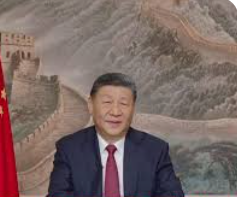
China’s leadership has once again placed Taiwan at the center of its long-term strategic vision, with President Xi Jinping expressing confidence that the island will eventually “come together” with the
mainland during a high-profile meeting with Taiwan’s opposition figure Cheng Li-wun.
The remarks, delivered during a rare cross-strait political exchange in Beijing, highlight both Beijing’s consistency on the issue—and the growing geopolitical weight surrounding it.
A Message of Inevitability
Xi’s statement reflects a familiar but firmly held position: that reunification is not just a goal, but an eventual outcome.
Chinese leadership has long framed Taiwan’s future as tied to the mainland, emphasizing “peaceful reunification” while refusing to rule out other options. The language of confidence—rather than urgency—signals a strategy rooted in patience, influence, and long-term positioning rather than immediate escalation.
In this framing, time is seen as an ally.
Why the Opposition Matters
The choice of counterpart is significant. Cheng leads the Kuomintang (KMT), Taiwan’s main opposition party, which traditionally favors closer ties with Beijing compared to the ruling government.
Her visit—the first of its kind in a decade—has been presented as a “peace mission,” aimed at reducing tensions and reopening dialogue
For Beijing, engaging Taiwan’s opposition serves multiple purposes:
- It creates an alternative channel of communication outside the current government
- It reinforces voices within Taiwan that support dialogue over confrontation
- It helps shape internal political dynamics on the island
In essence, diplomacy is being used not just across borders, but within them.
Cooperation as Strategy
Beyond reunification rhetoric, Xi emphasized cooperation—economic, cultural, and political—as the pathway forward.
This reflects a broader Chinese approach: integrating Taiwan gradually through incentives and engagement rather than relying solely on coercion. Trade, investment, and people-to-people exchanges are positioned as tools to narrow differences over time.
Yet this approach exists alongside sustained military pressure, including frequent drills near Taiwan—highlighting a dual-track strategy of engagement and deterrence.
Taiwan’s Divided Landscape
The visit also underscores internal divisions within Taiwan itself.
While the opposition advocates dialogue and reduced tensions, the ruling government maintains that Taiwan’s future must be decided solely by its people—and rejects Beijing’s sovereignty claims.
Public opinion on the island has consistently shown limited support for unification under China’s proposed frameworks, creating a complex political environment where external diplomacy intersects with domestic identity. (Reuters)
A Broader Geopolitical Context
The meeting comes at a sensitive moment. Rising U.S.–China competition, increased military activity in the region, and the prospect of renewed high-level diplomacy all raise the stakes.
Taiwan is no longer just a regional issue—it is a focal point in global power dynamics.
By engaging Taiwan’s opposition ahead of possible international negotiations, Beijing appears to be:
- Reinforcing its narrative of eventual reunification
- Expanding its diplomatic options
- Positioning itself ahead of future talks involving global powers
The Bottom Line
Xi’s message was clear: reunification is not being framed as a question of if, but when.
However, the path toward that outcome remains deeply contested—politically, socially, and internationally.
For now, the meeting highlights a critical reality:
the future of Taiwan will be shaped not only by military power, but by political influence, internal divisions, and long-term strategic patience.