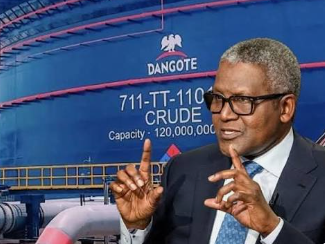
Nigerian billionaire Aliko Dangote has confirmed plans to build a major oil refinery on Kenya’s Lamu Island, telling the BBC the project marks his most ambitious energy investment outside Nigeria as he seeks to replicate the success of his Lagos refining complex.
The facility, expected to cost up to $17 billion, will have capacity to process 700,000 barrels of crude a day, according to Dangote Industries executives — roughly on par with the group’s single-site refinery in Lagos, currently the largest in Africa.
Vice President for oil and gas Edwin Devakumar said site selection for Lamu was complete, with soil testing under way and engineering and design work already started. He said Kenya had been the group’s preferred location from the outset, despite earlier speculation that Tanzania’s port city of Tanga might be chosen instead.
The refinery is intended to supply Kenya, Uganda, Tanzania, South Sudan and other neighboring countries — a region that currently imports nearly all of its refined petroleum products following the 2013 closure of Kenya’s last operating refinery.
Kenyan President William Ruto has welcomed the investment as a milestone for the country’s ambitions to become a regional energy hub, and has said a groundbreaking date has been set. His government sees the project as a potential anchor for the long-stalled Lamu Port-South Sudan-Ethiopia transport corridor, a multinational infrastructure initiative that has struggled to attract major investment since it was conceived more than a decade ago.
Dangote Industries said the project would be financed through a mix of internal cash flow, bond sales and proceeds from a planned initial public offering, limiting its reliance on external debt. Construction is expected to take roughly three years once it begins.
The proposal has not been without controversy. Lamu’s old town is a UNESCO World Heritage site surrounded by mangrove forests and coral reefs, and environmental groups have raised concerns about the refinery’s ecological impact and its compatibility with global climate targets. The decision to site the plant in Kenya has also stirred regional rivalry, with Tanzania previously in contention as a host country before talks shifted in Kenya’s favor.
The move follows the 2024 launch of Dangote’s Lagos refinery, which took over a decade and cost more than $20 billion to complete after repeated delays tied to site relocation, currency depreciation, the pandemic and global inflation. Dangote is separately expanding that facility’s capacity to 1.4 million barrels per day, a target that would make it one of the largest refineries in the world.