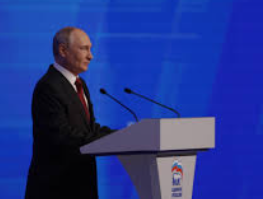
Russia’s Central Election Commission on Monday declared a sweeping victory for President Vladimir Putin’s ruling United Russia party in parliamentary elections, results that drew immediate condemnation from the European Union as a “sham” vote.
Election officials said United Russia secured close to 58 percent of the vote, giving it 355 of the 450 seats in the State Duma. It marked the first parliamentary election held since Russia launched its full-scale invasion of Ukraine in 2022. Turnout was reported at 59.32 percent, higher than the 51.7 percent recorded in the previous Duma election in 2021.
The vote was held over three days and offered voters a choice among several parties, all of which back Putin and support the war effort; no party opposed to the conflict in Ukraine was permitted to run. Election officials said the incoming Duma will include a number of newly elected lawmakers who served as military veterans in Ukraine. In the southern region of Chechnya, longtime regional leader Ramzan Kadyrov was reported to have won nearly all the vote in his district, a result that has drawn particular skepticism from independent observers.
EU foreign policy chief Kaja Kallas issued a sharply worded statement following the results, saying the election represented a further blow to democratic norms in Russia and that its outcome had never been in doubt. She accused the Kremlin of suppressing opposition voices, excluding the only registered anti-war party from the ballot, and denying entry to international election monitors. Kallas said what remains in Russia today is merely the appearance, rather than the substance, of democratic governance. She added that she would propose new sanctions targeting individuals involved in organizing voting in Ukrainian territory currently under Russian occupation.
The EU has already imposed sanctions on roughly 3,000 Russian officials and entities since the start of the war, including on Putin himself.
Western governments have repeatedly dismissed Russian elections held since 2022 as neither free nor competitive, pointing to the absence of genuine opposition candidates and tight state control over media coverage. Moscow has consistently rejected such criticism, with officials asserting that its elections meet legal standards and reflect genuine public support for the government’s direction.