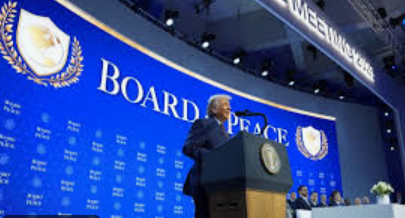
President Trump has announced that a newly formed international body known as the Board of
Peace will soon unveil more than $5 billion in pledged funding for the reconstruction of Gaza, a territory devastated by years of war, displacement, and humanitarian collapse.
Speaking ahead of the group’s inaugural meeting in Washington, President Trump said the Board of Peace represents a new global framework designed to stabilize conflict zones, mobilize reconstruction resources, and prevent prolonged cycles of violence.
The announcement comes as Gaza faces one of the largest rebuilding challenges in modern history, with international organizations estimating that restoring basic infrastructure could cost tens of billions of dollars.
A New International Initiative
According to President Trump, the Board of Peace includes more than 20 member states drawn from regions such as the Middle East, Southeast Asia, and beyond. The body was established following a United Nations Security Council resolution and was first introduced publicly at the World Economic Forum earlier this year.
Trump, who has positioned himself as chair of the initiative, described it as a potentially transformative institution for post-war recovery.
The $5 billion pledge, he said, is intended as an early step toward rebuilding Gaza’s shattered homes, schools, hospitals, and utilities — and toward laying the groundwork for longer-term stability.
While full details of donor countries have not yet been released, Trump said commitments are expected to expand as more partners join the effort.
Gaza’s Enormous Reconstruction Needs
The announcement highlights the scale of Gaza’s crisis.
After more than two years of devastating conflict, much of the enclave’s infrastructure has been destroyed. Entire neighborhoods have been reduced to rubble, health services have collapsed, and hundreds of thousands remain displaced.
International assessments by the United Nations, World Bank, and European Union estimate that rebuilding Gaza could cost around $70 billion, far exceeding the initial $5 billion pledged by the Board of Peace.
Nevertheless, analysts say early reconstruction funding is critical for:
- Restoring electricity and clean water systems
- Rebuilding damaged hospitals and clinics
- Providing emergency housing and shelters
- Restarting basic economic activity
- Supporting humanitarian aid distribution
The pledged funds could serve as a foundation for larger donor mobilization, though much more will be required.
Beyond Aid: Stabilization and Security Plans
President Trump indicated that the Board of Peace’s role may go beyond reconstruction funding alone.
He suggested that member states could contribute personnel to support stabilization efforts, including policing and security functions in Gaza once conditions allow.
One of the most notable early commitments reportedly comes from Indonesia, which has indicated that up to 8,000 troops could be prepared by mid-2026 for peacekeeping and humanitarian support roles under an international mandate.
Such proposals remain politically sensitive, as questions over Gaza’s governance and future security arrangements remain unresolved.
However, supporters of the initiative argue that reconstruction cannot succeed without stability, coordination, and credible international oversight.
Fragile Ceasefire, Continuing Violence
The reconstruction announcement arrives amid an uneasy and fragile ceasefire between Israel and Hamas.
While large-scale fighting has decreased, violence has not fully stopped. Recent reports of Israeli airstrikes and Palestinian casualties demonstrate that tensions remain volatile even as international actors begin planning for Gaza’s future.
Humanitarian agencies have repeatedly warned that rebuilding efforts will face enormous obstacles unless a durable political settlement is reached.
Without long-term peace, reconstruction risks being temporary — with rebuilt infrastructure vulnerable to renewed conflict.
A Shift in Global Diplomatic Strategy
The creation of the Board of Peace reflects a broader shift in how Washington is seeking to shape post-war recovery.
Traditionally, Gaza reconstruction has been coordinated through established multilateral mechanisms such as the United Nations, the European Union, and regional Arab donors.
The Board of Peace, however, appears to represent a U.S.-backed effort to establish a new framework — one that combines donor funding, stabilization planning, and international security cooperation under a single body.
Supporters argue that existing mechanisms have often been too slow, fragmented, or politically constrained to address crises of Gaza’s magnitude.
Critics, however, worry that the Board could overlap with or complicate traditional UN-led processes.
Some Western allies have reportedly expressed caution, seeking clarity on how the Board will operate alongside existing institutions.
Key Challenges Ahead
While the announcement of $5 billion in pledges is significant, the Board of Peace faces multiple challenges that will determine whether it can have a lasting impact.
1. Funding Scale
The most immediate issue is the sheer gap between pledged resources and actual needs.
With reconstruction estimates near $70 billion, the current pledge represents only a small fraction of what will ultimately be required.
Securing additional commitments from Gulf states, European donors, Asian partners, and international financial institutions will be essential.
2. Transparency and Accountability
As of now, the Board has not released a full list of contributors or a breakdown of how funds will be allocated.
Reconstruction in Gaza has historically been plagued by concerns over corruption, political diversion of aid, and logistical barriers.
International donors will likely demand strict oversight mechanisms to ensure funds reach civilian rebuilding projects.
3. Governance and Political Future
Perhaps the greatest challenge is political: who will govern Gaza, and under what framework?
Reconstruction cannot be separated from governance, security arrangements, and the broader Israeli-Palestinian conflict.
Without clarity on Gaza’s future administration, large-scale investment may remain uncertain.
4. Security Risks
Any international stabilization mission would operate in a highly sensitive environment.
Deploying foreign personnel, peacekeepers, or police forces could provoke political backlash from regional actors, armed groups, or local communities.
Ensuring neutrality and legitimacy would be critical.
Global Reactions and Strategic Stakes
The Board of Peace announcement has generated wide international attention, as Gaza remains one of the most urgent humanitarian crises in the world.
Many observers see reconstruction as a moral and strategic necessity.
Failure to rebuild could deepen desperation, fuel radicalization, and prolong instability across the Middle East.
At the same time, the effort represents a major geopolitical undertaking, involving competing regional interests, unresolved conflict dynamics, and enormous financial costs.
If successful, the Board could become a model for international post-war recovery efforts.
If unsuccessful, it could join a long list of stalled reconstruction promises in the region.
What Comes Next?
The Board of Peace is expected to formally unveil its funding pledges and operational plans at its first meeting in Washington later this week.
Key questions expected to emerge include:
- Which countries are providing the $5 billion?
- How will funds be distributed and monitored?
- Will there be an international stabilization force?
- How will the Board coordinate with the United Nations?
- Can reconstruction proceed without a final political settlement?
For now, the announcement signals an early but important step toward Gaza’s recovery — and a reminder that rebuilding after war is not only about money, but also about diplomacy, security, and long-term political solutions.
Conclusion
President Trump’s announcement that the Board of Peace will unveil $5 billion in reconstruction pledges marks a significant development in international efforts to rebuild Gaza.
While the funding is modest compared to the territory’s enormous needs, it could provide momentum for broader global engagement at a time when Gaza’s humanitarian crisis remains acute.
Whether the Board of Peace becomes a meaningful instrument for recovery or another symbolic initiative will depend on what follows: expanded funding, credible governance planning, and above all, sustained peace.