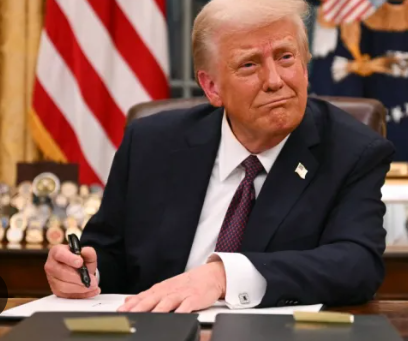
President Trump has unveiled a temporary 10 percent tariff on imported goods worldwide, just after the U.S. Supreme Court struck down a previous, broader tariff framework introduced under his administration.
The court ruled that the earlier tariff structure exceeded executive authority, stating that sweeping trade measures of that scale require clearer congressional approval. The decision represented a significant legal setback for one of President Trump’s central economic strategies — using tariffs as leverage in global trade negotiations.
Rather than retreating from tariff policy, President Trump moved swiftly to introduce a new, scaled-back measure. The 10 percent global tariff is designed as a temporary action, intended to stabilize trade policy while his administration reviews alternative legal pathways.
Why the Tariffs Matter
Tariffs have long been a cornerstone of President Trump’s economic agenda. He argues that import duties protect American industries, reduce trade deficits, and encourage companies to bring manufacturing back to the United States.
Supporters see the temporary tariff as a strategic reset — a way to maintain pressure on trading partners while respecting the Supreme Court’s limits on executive power.
Critics, however, warn that even a temporary universal tariff could raise costs for consumers, disrupt supply chains, and invite retaliatory trade measures from key partners in Europe, Asia, and Latin America.
Legal and Political Fallout
The Supreme Court’s decision reinforces the constitutional balance between the executive branch and Congress in matters of taxation and trade. It also signals that courts are prepared to closely scrutinize the scope of presidential authority in economic policymaking.
On Capitol Hill, reactions have been mixed. Some lawmakers are calling for clearer legislation defining tariff powers, while others argue the executive branch should retain broad flexibility in responding to global economic threats.
Global Implications
Because the United States remains the world’s largest consumer market, any across-the-board tariff has ripple effects worldwide. Export-dependent economies could feel immediate pressure, while multinational corporations may need to reassess pricing and logistics strategies.
Markets are expected to monitor how long the temporary tariff remains in place and whether Congress moves to formalize or restrict future trade actions.
For now, President Trump’s announcement underscores one reality: trade policy remains a powerful and politically charged instrument in shaping global economic relations.