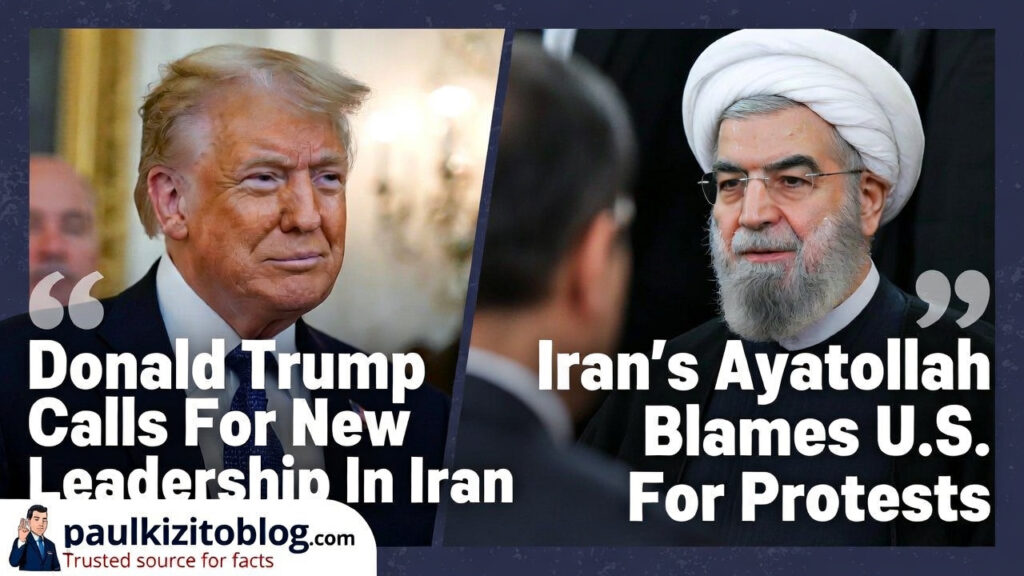
The recent exchange between former United States President Donald Trump and Iran’s Supreme Leader, Ayatollah Ali Khamenei, highlights a familiar tension in global politics: the struggle between internal unrest and external influence.
At a time when Iran is facing widespread protests and growing public dissatisfaction, two sharply different interpretations have emerged. Donald Trump has argued that Iran needs what he calls “new leadership,” while Ayatollah Khamenei has blamed the United States—particularly Trump—for fueling unrest and violence within the country.
To fully understand the meaning and implications of these statements, it is important to examine the political context, the roots of the protests, and the broader consequences for Iran and the international community.
Trump’s Statement and Its Broader Meaning
Donald Trump’s call for “new leadership” in Iran reflects his long-standing position on the Iranian government. During his time in office, Trump consistently criticized Iran’s political system, arguing that it prioritizes ideology and regional influence over the welfare of its citizens.
In his recent remarks, Trump linked Iran’s ongoing protests to what he views as deep failures in governance. Rising inflation, economic hardship, and restrictions on personal freedoms have placed significant pressure on Iranian society. From Trump’s perspective, repeated waves of public protest suggest that the current leadership is unable—or unwilling—to address these challenges effectively.
It is important to note that Trump’s comments are political in nature. They align with his broader belief that strong pressure, rather than diplomatic engagement, is the most effective way to deal with Iran. His remarks are also aimed at a global audience that has long expressed concern over human rights and economic conditions in the country.
However, calling for leadership change from outside Iran carries its own risks, particularly in a region where foreign intervention is viewed with deep suspicion.
Khamenei’s Response and Iran’s Official Narrative
Ayatollah Ali Khamenei’s response to Trump’s remarks fits within a long-standing narrative used by Iran’s leadership. According to this view, unrest inside the country is often encouraged or manipulated by foreign powers seeking to weaken Iran.
By blaming Trump and the United States for violent protests, Khamenei is framing the situation as part of a broader struggle against external interference. This framing serves several purposes.
First, it shifts attention away from internal challenges such as economic mismanagement and social frustration. Second, it reinforces national unity among supporters of the government by presenting Iran as a country under threat. Third, it provides justification for security measures taken in response to demonstrations.
From the Iranian leadership’s perspective, public calls for leadership change from a U.S. president appear to confirm fears of foreign efforts to influence Iran’s internal affairs.
The Protests: Domestic Roots and Global Attention
While international rhetoric has drawn attention to Iran’s protests, their origins remain largely domestic. Many Iranians are struggling with the cost of living, limited job opportunities, and restrictions on political and social expression.
Sanctions have played a role in weakening the economy, but internal policy decisions have also contributed to public frustration. These demonstrations reflect a complex mix of economic pressure, generational change, and unmet expectations.
At the same time, global attention has amplified the protests. Statements from foreign leaders, international media coverage, and diplomatic reactions all shape how the unrest is perceived beyond Iran’s borders.
For some outside observers, the protests represent a push for reform. For Iran’s leadership, they represent a security challenge influenced by external pressure.
Historical Tensions Between Iran and the United States
The sharp tone of this exchange cannot be separated from the long history of strained relations between Iran and the United States.
Since the 1979 Iranian Revolution, mistrust has defined interactions between the two countries. U.S. sanctions, Iranian resistance to Western influence, and disagreements over regional security have created a cycle of confrontation.
Donald Trump’s presidency intensified these tensions, particularly after the United States withdrew from the nuclear agreement and imposed sweeping sanctions. For Iran’s leadership, Trump has come to symbolize a period of maximum pressure and diplomatic breakdown.
This history explains why his recent comments carry significant weight in Tehran, even though he is no longer in office.
Can External Pressure Lead to Change?
A key question raised by this situation is whether calls for leadership change from abroad can lead to meaningful reform.
In Iran’s case, external pressure has often strengthened conservative elements within the political system. When faced with perceived foreign threats, authorities tend to tighten control rather than open space for dialogue.
This does not mean that change within Iran is impossible. Rather, it suggests that lasting reform is more likely to come from internal social and political processes than from outside demands.
Public statements from foreign leaders may draw attention to human rights concerns, but they can also reinforce narratives that discourage compromise.
Regional and Global Implications
Developments inside Iran have consequences far beyond its borders. Iran plays a significant role in regional politics, energy markets, and security dynamics across the Middle East.
Continued unrest, combined with heightened rhetoric between Tehran and Washington, increases uncertainty in an already fragile region. While neither side appears to be seeking direct confrontation, sharp language can complicate diplomatic efforts and raise tensions.
For the international community, the challenge lies in balancing concern for human rights with respect for national sovereignty and regional stability.
Conclusion: Competing Interpretations of Iran’s Future
At its core, this dispute reflects two competing interpretations of Iran’s current situation.
Donald Trump views the protests as evidence of failed leadership and a public desire for change. Ayatollah Khamenei views them as a product of foreign interference aimed at destabilizing the country.
Both perspectives highlight real aspects of the crisis, yet neither fully captures its complexity.
Iran’s challenges are deeply rooted, involving economic pressures, political structures, and social expectations. External voices can influence the conversation, but the future direction of the country will ultimately depend on decisions made within Iran itself.
As global attention remains focused on these developments, one thing is clear: the situation in Iran is not only a domestic issue, but a matter with wide-ranging international significance.