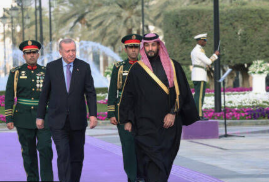
Turkey, Saudi Arabia and Pakistan will establish political and military coordination mechanisms under a defence pact signed last week, Turkey’s defence ministry said on Thursday, adding the alliance would also deepen defence industry cooperation.
The three countries signed the “Mecca Joint Defence Agreement” on Aug. 7, uniting the Sunni Muslim U.S. allies at a moment of regional alarm over Iranian missile fire striking Gulf oil exporters.
Background
The pact was signed in Mecca by Turkish President Tayyip Erdogan, Saudi Crown Prince Mohammed bin Salman and Pakistani Prime Minister Shehbaz Sharif. It states that an armed attack on any one of the three nations will be treated as an attack on all — a mutual-defence clause modeled on NATO’s Article 5.
It builds on a bilateral Saudi-Pakistan defence pact signed in September 2025, now expanded to fold in Turkey’s defence-industrial base and NATO-standard armed forces.
Why it matters
The agreement comes as the U.S.-Israel war on Iran continues, with Houthi attacks from Yemen and missile and drone strikes hitting Gulf states, and as questions grow in the region over Washington’s reliability as a security guarantor. The three countries’ combined annual defence budgets total roughly $124 billion, according to Global Firepower — Saudi Arabia at $63.9 billion, Turkey at $51.4 billion and Pakistan at $9.1 billion.
Analysts describe the pact as combining a top global oil exporter (Saudi Arabia), NATO’s second-largest army and a sophisticated drone and defence-industrial base (Turkey), and the only nuclear-armed military in the Muslim world (Pakistan).
Reaction
Saudi Arabia has said the pact is not directed at any specific country and does not represent an attempt to build a sectarian or military “axis.” Erdogan said the agreement was rooted in collective deterrence, while reaffirming Turkey’s commitment to resolving disputes through diplomacy. Sharif called the pact a “historic endeavour.”
Some analysts caution the practical military integration remains limited for now, describing it as more a “strategic signal” than a fully operational alliance, with any shared command structure still years away.