
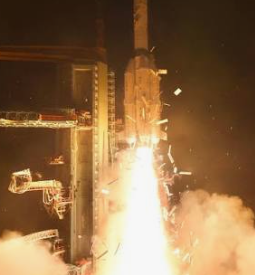
India’s space agency successfully launched its first Earth observation satellite designed for geosynchronous orbit early Friday, achieving a milestone the country had previously failed to reach.
A GSLV-F17 rocket lifted off at 2:55 a.m. local time from the Satish Dhawan Space Centre carrying the EOS-05 satellite, a 2,367-kilogram spacecraft intended to deliver near-real-time Earth imagery for uses including agriculture and disaster management. The mission marked the 19th flight of India’s Geosynchronous Satellite Launch Vehicle.
The rocket placed EOS-05 into a sub-geosynchronous transfer orbit, an elongated intermediate orbit from which the satellite must now use its own propulsion over the coming days to reach its final circular orbit roughly 36,000 kilometers above Earth. At that altitude, a satellite orbits at the same rate the planet rotates, allowing it to remain fixed over a single location — a significant advantage over India’s existing fleet of Earth observation satellites, which operate in low polar orbits passing over any given area only briefly, once every several days.
India had previously attempted to place an Earth-imaging satellite in geosynchronous orbit in August 2021, when the EOS-03 mission failed after an anomaly in the rocket’s third stage. Friday’s launch, following an eight-month gap after a January launch failure involving a separate rocket, extends a run of successful GSLV flights dating back to 2023.