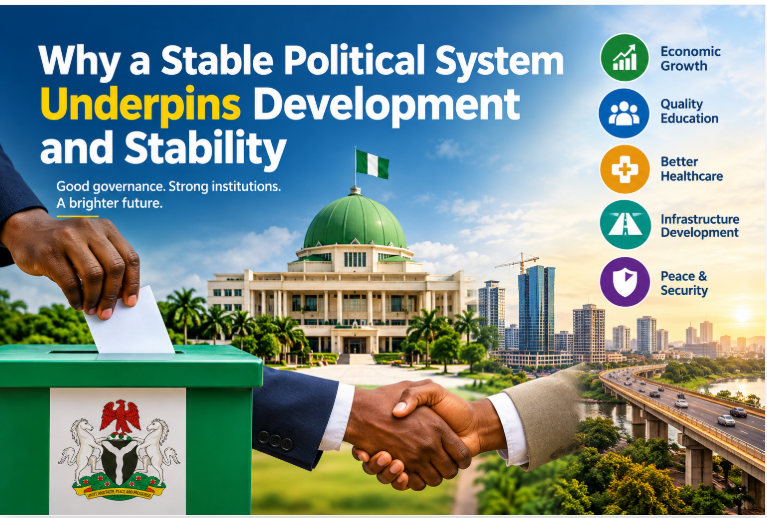
Political stability is among the most reliable predictors of a nation’s long-term economic and social trajectory. Capital, technology, and skilled labor can move to wherever conditions favor them, and they consistently favor environments defined by predictability over those defined by volatility. A stable political order, characterized by consistent rules, peaceful and lawful transitions of power, and credible institutions, provides the foundation on which sustained development is built. Its absence, by contrast, tends to erode economic prospects regardless of a country’s natural resources or human potential.
Investment decisions are, at their core, judgments about the future, and political stability lowers the risk premium attached to those judgments. Where property rights are secure, contracts are enforceable, and policy does not shift abruptly with each change of government, businesses can plan over extended time horizons rather than discounting for the possibility of expropriation, sudden regulatory reversal, or civil disorder. Economies that have sustained consistent governance over long periods have generally proven more successful in attracting durable capital inflows, precisely because investors are able to model future outcomes with reasonable confidence.
A defining feature of stable political systems is that governance rests on institutions rather than on individuals. Courts, central banks, civil services, and electoral bodies that operate independently of whoever holds executive power provide continuity across successive administrations. This continuity matters because development is inherently a long-run undertaking; infrastructure, education systems, and industrial policy require years or decades to mature. In systems where institutions are weak and authority is concentrated in individuals, each transition of power risks discarding the previous government’s initiatives, effectively resetting the pace of national development.
Instability also imposes direct and substantial economic costs. Contested elections, coups, insurgencies, and prolonged civil unrest damage infrastructure, disrupt trade, and accelerate capital flight. The indirect costs are frequently larger still: skilled citizens emigrate, foreign partners withdraw, sovereign credit ratings deteriorate, and government resources are diverted from development priorities toward security and crisis management. Nations that avoid this cycle are able to direct fiscal and human capital toward productive investment rather than toward recovery from repeated disruption.
Advanced economic activity, including manufacturing supply chains, financial markets, and industries built on intellectual property, depends on a predictable legal environment. Stable political systems are more likely to sustain an independent judiciary and consistent regulatory enforcement, both of which are prerequisites for complex economic coordination among parties who may never interact directly. Where legal outcomes can be overridden by political authority, economic actors tend to default to simpler and lower-trust transactions, which in turn constrains an economy’s capacity to develop more sophisticated and higher-value industries.
Political stability further shapes long-term social and economic behavior. Citizens who trust that the political order will endure are more inclined to make decisions oriented toward the future, including starting businesses, pursuing higher education, saving for retirement, and investing in family formation. Chronic instability encourages the opposite: short-term consumption over saving, informal economic activity over formal enterprise, and emigration over long-term domestic commitment. Over time, this divergence compounds into substantial disparities in human capital and economic output between stable and unstable states.
It is important to distinguish political stability from political stagnation or authoritarian control. The form of stability that supports development is procedural in nature, resting on predictable rules governing the transfer and exercise of power, rather than on the mere suppression of political competition. Democracies with strong institutions and orderly leadership transitions can remain highly stable despite frequent changes in government, while authoritarian systems that appear stable on the surface often conceal unresolved questions of succession, which can produce abrupt crises when leadership eventually changes. The decisive factor for development is therefore not the absence of political change, but the existence of a reliable and lawful process through which such change occurs.
Political stability functions as an enabling condition rather than a guarantee of development. It does not by itself produce economic growth, sound policy, or social progress. Its absence, however, reliably undermines all three, by increasing the cost of investment, weakening institutional continuity, diverting national resources toward conflict management, and discouraging the long-term commitments on which complex economies depend. For countries pursuing sustained development, the establishment of durable, rules-based political institutions is not a secondary concern to be addressed once growth has begun; it is frequently the precondition without which growth cannot be sustained at all.