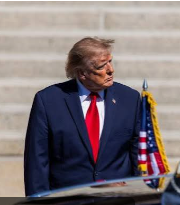
President Donald Trump said Saturday that he has rejected an Iranian proposal to reopen the Strait of Hormuz, telling reporters outside the White House that Tehran’s earlier decision to close the waterway had backfired on the Iranian regime itself.
Trump said the Iranian offer, which included resuming shipping through the strait, restarting nuclear negotiations and lifting the U.S. naval blockade of Iranian ports, was not acceptable, describing it as an attempt by Tehran to reopen the route immediately because Iran was, in his words, losing badly and running short of revenue that depends on the waterway. He argued that Iran had miscalculated by closing the strait in the first place, saying the move was intended to create difficulty for the broader world but instead prompted the United States to impose what he called the most extensive blockade in military history.
The president said dozens of vessels had continued moving through the strait under U.S. control despite the blockade, and characterized current U.S. policy in the region as succeeding decisively. He did not detail publicly why he chose to decline Iran’s specific terms, though people familiar with the deliberations told The Wall Street Journal that Trump remains privately skeptical Iran would follow through on any agreement, and expects to resume military action against Iran after the November midterm elections.
Trump’s rejection follows earlier remarks this week at the UN General Assembly, where he described a recent meeting with Iranian officials as productive while also warning that the United States could destroy Iran if no settlement is reached. On Saturday morning, he wrote on Truth Social that Iran cannot be permitted to possess a nuclear weapon.
Iranian President Masoud Pezeshkian said Thursday that the Middle East does not need what he called a regional policeman, arguing that security in the Strait of Hormuz can only be achieved through negotiation. Pezeshkian said talks between Tehran and Washington have continued through intermediaries including Qatar and Pakistan, while asserting that Iran has lost trust in the United States following repeated military strikes during the negotiating process.
Separately, U.S. Ambassador to the United Nations Mike Waltz said Saturday that a record 146 countries had joined in condemning Iran over attacks on commercial shipping. The State Department has also moved to sanction companies conducting business with Iranian airlines as part of a broader campaign to isolate Iran’s economy.