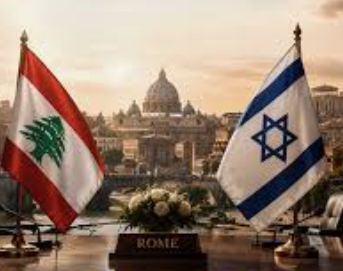
Lebanese and Israeli delegations concluded a third and final day of U.S.-brokered negotiations in Rome on Thursday, with a senior Lebanese official describing progress on some fronts but no resolution on the most contentious issues, including where to expand so-called pilot zones for an Israeli troop withdrawal.
The talks, held at the U.S. Embassy in Rome, ran across three parallel tracks covering military, political, legal and border matters, along with discussions on prisoners. Negotiators reportedly spent time working through technical military terminology, while talks on prisoners proceeded along separate tracks — one addressing applicable international law, the other focused on exchanging prisoner lists. The Lebanese official said that issue remains difficult for Beirut, which lacks complete lists of its own, though he called the discussion constructive and said there were efforts to bring the International Committee of the Red Cross into the process.
On the question of expanding pilot zones — areas where Israeli forces withdraw as Lebanese troops move in to confirm Hezbollah’s disarmament — the Israeli delegation reportedly pressed for more detail on proposed locations, including geographic and security considerations. Lebanon put forward several sites, among them the town of Zawtar al-Sharqiya in Nabatieh province, but officials said no agreement was reached.
Negotiators also discussed the possibility of a new border security arrangement, with disagreement over whether such a deal should be anchored in United Nations authority or the Washington-led framework instead.
Notably absent from the formal agenda, according to the Lebanese official, was Israel’s recent escalation in southern Lebanon — including demolitions near existing pilot zones — which he said is instead being handled through a separate mechanism established last October. Lebanon has said it received a U.S. pledge to address its complaints about alleged Israeli ceasefire violations.
This was the second round of talks hosted in Rome, following five earlier sessions in Washington since negotiations began in April under U.S. mediation, after Hezbollah’s rocket fire on Israel in March—in support of Iran—triggered a war that Lebanese officials say has killed more than 4,300 people. A framework agreement signed in Washington on June 26 laid out a phased Israeli withdrawal in exchange for Hezbollah’s disarmament and the deployment of the Lebanese army, but implementation has been complicated by continued Israeli military activity in the south, which Beirut says violates the deal.
Officials floated September 1 as a preliminary date for an eighth round, though Washington said it would continue consulting both sides before finalizing a schedule.