
By Paulkizitoblog media
Independent Public Health & Policy Analysis
There are two types of health crises; those that come loudly and get on the TV news.
Then there are the silent ones, slowly creeping up on you.
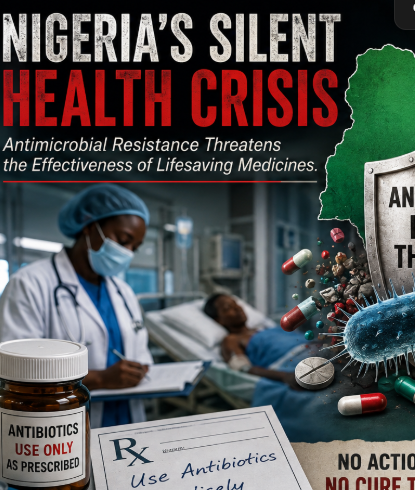
Antimicrobial resistance (AMR) is one of these silent crises.
It does not come with the kind of fanfare that makes GOSTOP, the media, and political leaders pay attention immediately.
Instead, it quietly erodes one of our most potent defenses – pharmaceuticals – rendering a significant portion of them useless.
When microbes become resistant to antimicrobial drugs, the infections they cause become harder, more expensive, and sometimes even impossible to treat.
This is a growing public health concern in Nigeria, one that requires our sustained attention and action.
According to the World Health Organization, 263,400 people in Nigeria died as a result of antimicrobial resistance in 2019.
Nigeria also launched its first-ever nationally representative antimicrobial survey in December 2025.
These are all positive developments, but they don’t tell us the whole story.
What the statistics don’t say is that antimicrobial resistance is a harbinger of things to come.
How normal infections can become super infections
Pharmaceuticals have significantly improved our lives.
They have paved the way for surgeries, cancer treatments, transplantations, intensive care, and so on.
However, this is only possible so long as the pathogens we fight with antibiotics, anti-parasitic, anti- fungal, and anti-viral drugs have not become resistant to them.
The more antibiotics are misused and overused, the more resistant pathogens become to them.
Once a patient has an infection that is resistant to treatment, a lot can happen.
The treatment course is made more difficult and expensive as the physician tries to figure out what works.
As a result, the patient is sick for a much longer time.
This is a problem both for the individual and for the healthcare system as a whole.
Self medication is not the real problem
When discussing antimicrobial resistance in Nigeria, many will talk to you about self-medication.
This is an important phenomenon as people who self- medicate often take antibiotics when they are not needed, thereby contributing to antimicrobial resistance.
However, this is only one part of the story.
Nigerians may self-medicate because adequate treatment is not always available.
Patients may share medications with each other, use old antibiotics, or stop taking them when their symptoms begin to improve.
At the same time, healthcare facilities may have a shortage of diagnostic equipment, staff, and laboratory tests.
This puts healthcare workers in a difficult position as they try to choose the appropriate antimicrobial treatment for a condition when the diagnostics are not there.
This means that Nigeria’s antimicrobial resistance problem cannot be solved by advising Nigerians not to self-medicate.
The country needs to make sure that healthcare is accessible enough so that self-medication is not the preferred option.
…And the hospitals
Health facilities play a crucial role in fighting antimicrobial resistance.
Not only are they where many patients seek treatment for infections, they also use a lot of antimicrobial agents.
This means that health facilities should take a leading role in antimicrobial stewardship, ensuring that antibiotics and other anti-infective pharmaceuticals are used appropriately.
One of the most important aspects of antimicrobial stewardship is diagnostic testing.
So long as healthcare workers do not have adequate diagnostics, they will have a hard time determining what antimicrobial, if any, to prescribe.
Furthermore, infection control is an essential part of reducing antimicrobial resistance.
After all, every infection prevented is an infection that does not need antimicrobial treatment.
This includes sanitation, water, vaccination, sterilization, infection control in hospitals, and other similar measures.
Nigeria is not helpless
Nigeria has taken a number of important steps in confronting antimicrobial resistance.
The Federal Government’s Second National Action Plan on Antimicrobial Resistance, which covers the 2024-2028 period, was developed with a One Health approach in mind.
This means that the plan acknowledges the connection between human health, animal health, agriculture, and the environment.
Nigeria is also taking steps to improve surveillance of antimicrobial resistance and has launched the country’s first national survey with the assistance of the World Health Organization (WHO).
According to WHO, the survey, which started in December 2025, will cover 40 – 45 health facilities and will focus on finding out the patterns of suspected bloodstream infections.
This is an important step because Nigeria needs to have good surveillance data before it can develop effective antimicrobial resistance control policies.
Nigeria needs to know where the problem is, what organisms are responsible, what antimicrobials are ineffective against them, and who is most at risk.
One Health is central to fighting antimicrobial resistance
The One Health concept is central to Nigeria’s strategy for fighting antimicrobial resistance.
AMR is a multi-sectoral issue that affects humans, animals, agriculture, the environment, healthcare, and even pharmaceutical companies.
It is therefore necessary to take a holistic approach to combating it.
That is the idea behind One Health.
The way Nigeria combats antimicrobial resistance will determine whether the country’s efforts are effective in the long run.
A lot of what needs to be done falls under the purview of the Ministry of Health, but other sectors play a role too.
These include agriculture, animal health, the environment, pharmaceuticals and regulators, infection control, laboratories, academia, and of course, the general public.
When an infection breaks out in a hospital, there is a possibility that it could be resistant to treatment.
That infection may have come from somewhere else, and the fact that it is resistant may impact the response.
That’s why Nigeria’s approach to fighting antimicrobial resistance needs to be inter-sectoral, something the One Health concept is all about.
The true test of this plan is implementation
Nigeria has plans and policies in place to combat antimicrobial resistance.
Now, the country needs to actually implement them.
The Federal Government’s policies are a good start, but they will not be enough on their own.
Nigeria needs funding, surveillance, regulation, diagnostics, healthcare workers, the general public’s support, and more if it wants to reduce antimicrobial resistance.
The last thing Nigeria needs at this point is another policy framework that gathers dust on a shelf.
This is especially important when it comes to Nigeria’s new action plan for tackling antimicrobial resistance.
Unless concrete steps are taken to ensure implementation, it will not matter how good the plan is on paper.
There must be quantified targets, indicators for monitoring and evaluation, transparency, and domestic funding for the plan to work.
So, what can Nigeria do?
Nigeria’s response to antimicrobial resistance should be focused on specific areas.
The first is laboratory response and diagnostics.
Unless Nigeria has appropriate diagnostics, it will not be able to prescribe the right antimicrobial to a patient.
That is why it is so important to have functioning laboratories and appropriate transport for transporting samples to them.
The next step is antimicrobial stewardship, which involves making sure that antimicrobials are prescribed appropriately.
Hospitals must have policies that promote appropriate antimicrobial use, including monitoring and reporting mechanisms.
The issue of self-medication must also be addressed.
Nigerians need to understand that antibiotics are not the answer to every illness.
However, it is also important to create access to healthcare so that individuals do not turn to self-medication in the first place.
Regulation is another key issue that needs to be addressed.
Antimicrobials must be prescribed and dispensed responsibly.
At the same time, appropriate antimicrobial treatment must be available to those who need it.
National surveillance must also be strengthened.
The results of Nigeria’s national antimicrobial survey need to be used to create a surveillance system for antimicrobial resistance in Nigeria.
This system should be sustainable and capable of producing the kind of data that can inform the development of antimicrobial resistance control policies.
Agriculture and animal health are also important areas that need to be addressed.
The use of antimicrobials in livestock production must be monitored and Nigeria’s AMR surveillance system should include animal health as well.
Environmental issues associated with antimicrobial resistance, such as healthcare waste, need to be addressed as well.
The public has a role to play as well
The public needs to know that antimicrobial resistance is a serious health issue that affects everyone.
Individuals should not take antibiotics unless they are prescribed by a qualified medical professional.
It is important to get adequate care when sick and to only take medication as prescribed.
People should not share antibiotics or use old antibiotics to treat a new illness.
Most importantly, the public needs to know that not every infection is treated with antibiotics.
That way, they can help reduce antimicrobial resistance.
The economic implications of antimicrobial resistance
The economic implications of antimicrobial resistance are also significant.
Drug- resistant infections often require longer hospital stays and more elaborate diagnostic, surveillance, and treatment procedures.
This places a strain on both the individual and the healthcare system.
With the rising cost of treatment in Nigeria, drug- resistant infections can quickly become unaffordable.
This is a problem for the individual as well as the government, which has to subsidize treatment or deal with high insurance claims.
Furthermore, businesses and the Nigerian economy at large also suffer from sicknesses as workers are forced to stop working for extended periods of time.
The implications of antimicrobial resistance go well beyond the cost of a few antibiotics.
We need to think long- term
One of the reasons why antimicrobial resistance requires our immediate attention is that pharmaceuticals and the procedures they enable are foundational to medicine.
If they become unreliable, the effects can be felt throughout the healthcare system.
Many procedures and treatments that we take for granted, such as surgery and post- delivery care, can become more complicated and hazardous.
This presents a significant threat to public health.
Conclusion: it’s not too late for Nigeria
Despite the gravity of the situation, it is important to remember that things are not as bad as they seem.
There is still much that can be done to reduce antimicrobial resistance.
Appropriate prescription, diagnostics, infection control, vaccines, sanitation, surveillance, regulation, education, and responsible antimicrobial use all contribute to the fight against antimicrobial resistance.
Nigeria is already making important steps in that direction.
The country’s National Action Plan on Antimicrobial Resistance and the recently launched national survey are examples of that.
The next step is to actually implement these policies.
The most important question in Nigeria’s fight against antimicrobial resistance is not whether it is a problem or not, but rather whether Nigeria is willing to do whatever it takes to control it.
The silent emergency is already here, and it is time to take action before it becomes impossible to reverse.










