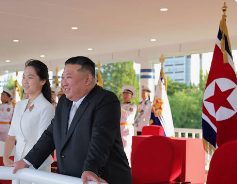
North Korean leader Kim Jong Un put a second guided-missile destroyer into service on Sunday, commissioning the Kang Kon at a ceremony in the eastern port city of Wonsan just as the United States, South Korea and Japan launched a five-day trilateral naval exercise Kim regards as a security threat.
The 5,000-ton vessel joins its sister ship, the Choe Hyon, commissioned roughly three months earlier, as North Korea’s most advanced warships to date. Both are capable of carrying nuclear-capable missiles, and analysts believe Russia provided technical assistance in their construction, citing similarities between their missile and radar systems and those found on Russian vessels. In July, North Korea said it had test-fired nuclear-capable cruise missiles from the Kang Kon while Kim oversaw the drill.
Speaking at the ceremony, Kim called the destroyer an “offensive” asset integrated into the state’s nuclear counterattack system, and said the back-to-back commissioning of two such warships would deepen adversaries’ concerns. He renewed his call to build North Korea’s navy into a fully nuclear-armed force capable of carrying out maritime deterrence “more clearly,” and pledged continued investment in advanced naval assets. Kim’s teenage daughter, believed by South Korean intelligence to be his likely successor, attended alongside him.
The Kang Kon’s path to service was not smooth: the ship capsized during a botched launch attempt in May 2025, an incident Kim publicly called a “criminal act,” before being successfully relaunched about a month later. He had subsequently ordered it commissioned within two months of the July missile tests.
The commissioning lands amid heightened friction between Pyongyang and Washington. North Korea has rebuffed a recent U.S. offer to scale back a major joint exercise with South Korea, a step Washington had intended as a conciliatory gesture toward Kim; observers say Pyongyang is instead pressing for larger concessions. The U.S., South Korea and Japan began their “Freedom Edge” exercise Monday in waters off South Korea’s Jeju Island, a drill North Korea has previously criticized as provocative.