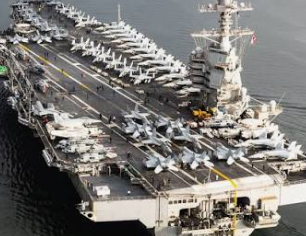
The United States is withdrawing its last remaining aircraft carrier from the Asia-Pacific region, leaving the western Pacific without a U.S. carrier presence for the first time in years as President Donald Trump’s administration channels naval resources toward its conflict with Iran and toward the Western Hemisphere.
The USS George Washington is departing the Pacific and is expected to relieve the USS Abraham Lincoln in the Middle East, where the Lincoln has remained on station well past its original return date to support operations against Iran. The Lincoln has now logged more than 240 consecutive days at sea, a stretch that has drawn scrutiny from lawmakers over reports of strained morale, supply shortages and mental health concerns among the roughly 5,000 sailors and Marines aboard.
Analysts said the shift underscores how open-ended military commitments in the Middle East are straining the Navy’s fleet of 11 carriers, even as the administration has repeatedly signaled that Asia, and increasingly the Western Hemisphere, should take precedence over the region. “The administration says that the Pacific is supposed to be the most important, behind the Western Hemisphere,” said Greg Poling, director of the Southeast Asia Program at the Center for Strategic and International Studies, adding that in practice the U.S. is “doing the exact opposite” of its stated goal of reducing its footprint in the Middle East.
The gap in carrier coverage comes as China has stepped up naval activity in the region, including exercises near Scarborough Shoal and around Japan. One defense analyst said Beijing is using the moment to project the message that Washington is “not the big dog” in the Pacific any longer. Officials and analysts noted the absence may be short-lived, with the Navy expected to deploy another carrier to the region within the next couple of months.
The strain follows an unusually demanding stretch for the carrier fleet under Trump’s second term. The USS Gerald R. Ford returned home in mid-May after an 11-month deployment, the longest since the Vietnam War era, during which it supported both the campaign against Iran and the operation that led to the capture of Venezuela’s former leader, Nicolás Maduro. That deployment was further extended after a fire broke out in a laundry space aboard the Ford, forcing the carrier back to the Mediterranean for repairs and leaving hundreds of sailors without berths.
Some regional partners in Asia have expressed unease over the unpredictability of U.S. posture in the Pacific, according to Poling, who said the uncertainty has left Beijing “quite happy” with the resulting distraction among American allies.
The Pentagon has not indicated a firm timeline for restoring a permanent carrier presence to the Asia-Pacific region.