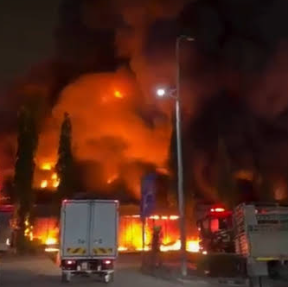
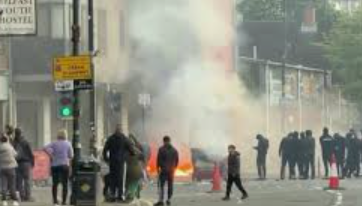
Belfast burned again on Tuesday night. Buses were torched on the Newtownards Road, cars set alight on
Lendrick Street, shops shuttered early, and police helicopters circled overhead as hundreds of masked protesters spread across multiple parts of the city — all of it triggered by a stabbing so savage that the footage of it, shared widely online by far-right figures, became the accelerant for disorder within hours of the attack.
The stabbing occurred around 10:30 on Monday night on Kinnaird Avenue in north Belfast. A man in his 40s was strapped to the pavement and stabbed repeatedly in the head, neck, eyes, and back with a kitchen knife. Bystanders intervened and restrained the attacker before police arrived. The victim was taken to hospital in serious condition — his injuries grave, his survival attributed in part to the people who stepped in. The suspect, a 30-year-old Sudanese man who had travelled to Northern Ireland from Dublin and held leave to remain in the United Kingdom, was arrested at the scene and charged with attempted murder. He is due before court on Wednesday. Police said they are not treating the attack as terrorism and are not looking for anyone else.
None of that context made it onto the social media feeds that drove people into the streets. What spread instead was the video — unfiltered, brutal, and stripped of any surrounding information — shared by far-right accounts calling for mass demonstrations against immigration. By Tuesday evening, several hundred people, many masked or wearing balaclavas, had gathered at multiple points across Belfast: the Newtownards Road, the Crumlin Road roundabout, the area around the Royal Victoria Hospital. At least three officers were injured. Thirteen reports of criminal damage and five of arson were logged by the Police Service of Northern Ireland. Four people were arrested on the first night.
Prime Minister Keir Starmer called the stabbing horrific and sickening, and made clear he had no tolerance for the violence that followed it. Political leaders in Northern Ireland — across the community divide — echoed calls for restraint and warned that misinformation was doing damage that would outlast the immediate unrest. The PSNI appealed for calm heads and urged witnesses to the original attack to come forward through proper channels.
What happened in Belfast on Tuesday night is now a familiar pattern in Britain and Ireland — a violent incident, a suspect from an immigrant background, footage weaponised online before facts are established, and streets alight within hours. It happened in Southport in 2024. It happened in Northern Ireland in 2025. The script barely changes. A man nearly lost his life on a north Belfast street on Monday. By Tuesday, that fact had been subordinated to a broader political argument in which his suffering was, for many on those streets, almost incidental.
Belfast returned to an uneasy quiet by Wednesday morning. The PSNI remained on heightened alert. Officials warned that the coming days would test the city’s patience — and its institutions — in ways that go well beyond the question of what happened on Kinnaird Avenue.