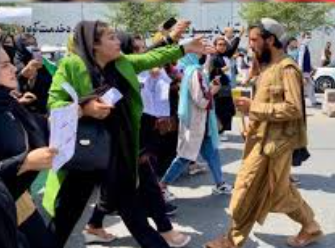
Taliban security forces opened fire on a crowd of protesters in the western Afghan city of Herat on
Tuesday, injuring at least three people in one of the starkest displays of state violence against public dissent since the movement returned to power in 2021.
The protest — involving between 100 and 150 people by eyewitness accounts — had gathered in response to the arrest and detention of more than a dozen women accused of violating the Taliban’s dress code. The trigger was a directive issued during Friday prayers the previous week, when imams in Herat’s mosques read announcements on behalf of the Ministry for the Propagation of Virtue and the Prevention of Vice instructing women that they were not permitted to leave their homes without wearing full hijab — a headscarf, a long robe covering the body entirely, and a face covering. Arrests began shortly afterwards.
What followed on Tuesday was unusual in a country where protest is illegal and dissent carries serious consequences. The fact that more than a hundred people took to the streets at all — and that the demonstration appears to have included both women and men — reflects a depth of anger that Taliban enforcement has not been able to entirely suppress, even nearly five years into its rule.
The morality police chief in Herat, in an audio message distributed to journalists, denied that women had been arrested for dress code violations, insisting that all women in the province observe Taliban rules. That denial contradicted eyewitness accounts and the UN’s own assessment. The UN Assistance Mission in Afghanistan, which had flagged the arrests on Sunday as raising serious human rights concerns, did not soften its position after Tuesday’s shooting. The UN’s special investigator on human rights in Afghanistan said he was alarmed by what he described as excessive force used against seemingly peaceful protesters, and called for accountability.
Human Rights Watch described the apparent use of lethal force as very concerning, and urged the Taliban to release those detained for protesting and to ensure the injured received medical care. The organisation also challenged the premise of the underlying arrests themselves — questioning the legitimacy of detaining women for what it called inappropriate clothing.
The incident lands the same week that the UN Security Council heard testimony on Afghanistan’s human rights situation, with a senior UN official accusing the Taliban of stripping women and girls of their most basic rights — to education beyond primary school, to employment, to freedom of movement, and to any meaningful participation in public life.
None of that international pressure has yet produced a change in Taliban policy. If anything, the enforcement activity in Herat suggests the movement is tightening its grip rather than loosening it — and that those who step into the street to object will be met with the same response they were on Tuesday.