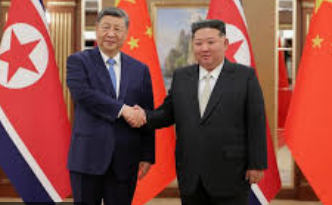
Xi Jinping returned from Pyongyang on Tuesday with the kind of communiqué that tells the world something happened — and almost nothing about what it was.
In a message of thanks to Kim Jong-un carried in full by North Korea’s state media, Xi said the two sides had exchanged in-depth views on issues of common concern and reached a series of important joint consensus — language carefully constructed to signal substance while revealing none. He added that he was committed to working with Kim on the basis of fundamental and long-term interests to safeguard, consolidate, and develop the bilateral relationship, and expressed a shared determination to contribute to regional and global peace.
The visit, which ran from June 8 to 9, was Xi’s first trip to North Korea in seven years and his first overseas journey of 2026 — a sequencing that carries its own message. It came weeks after Xi separately hosted both Vladimir Putin and Donald Trump in Beijing, positioning him across a remarkable few months as the one leader with an open door to every major actor in an increasingly fractured world order. Choosing Pyongyang as his first foreign destination of the year, ahead of any European or other major power capital, was not accidental.
The delegation Xi brought to Pyongyang was notably heavyweight — foreign minister Wang Yi, defence minister Dong Jun, and the head of the National Development and Reform Commission among them. The presence of the defence minister in particular attracted attention, though Chinese and North Korean readouts gave no indication of what, if anything, was agreed on military matters.
What drove the visit was a concern that has been building in Beijing for some time: that North Korea’s deepening partnership with Russia — troops deployed to fight in Ukraine, weapons flowing to Moscow, technology transfers flowing back — has quietly shifted the centre of gravity in Pyongyang away from China and toward a patron that asks fewer questions about nuclear ambitions. Xi’s two-day trip was, in part, a reassertion of Beijing’s relevance — a reminder to Kim that China remains his most consequential relationship, economically and diplomatically, whatever Russia is currently offering militarily.
For Kim, the optics were equally useful. Xi’s arrival was met with portraits lining Pyongyang’s streets, flags of both nations hung across the capital, and banners proclaiming eternal friendship in Korean and Chinese. Kim called Xi the most respected guest of the North Korean people and described the choice to make Pyongyang his first overseas stop of the year as a tremendous encouragement. The ceremony was a statement of the country’s standing — a demonstration, for domestic and international audiences alike, that North Korea is neither isolated nor without powerful friends.
What was actually agreed between the two men remains, as is almost always the case with summits in Pyongyang, largely unknown. The phrase important consensus is a fixture of Chinese diplomatic language that can cover everything from a genuine strategic alignment to a polite agreement to keep talking. Whether Xi pressed Kim on the country’s nuclear programme, carried any message from Trump about the possibility of resumed diplomacy, or extracted any commitment to restraint in weapons development — none of this has been made public, and may never be.
What is certain is that Xi made the journey. In the currency of diplomatic signals, that alone says a great deal.